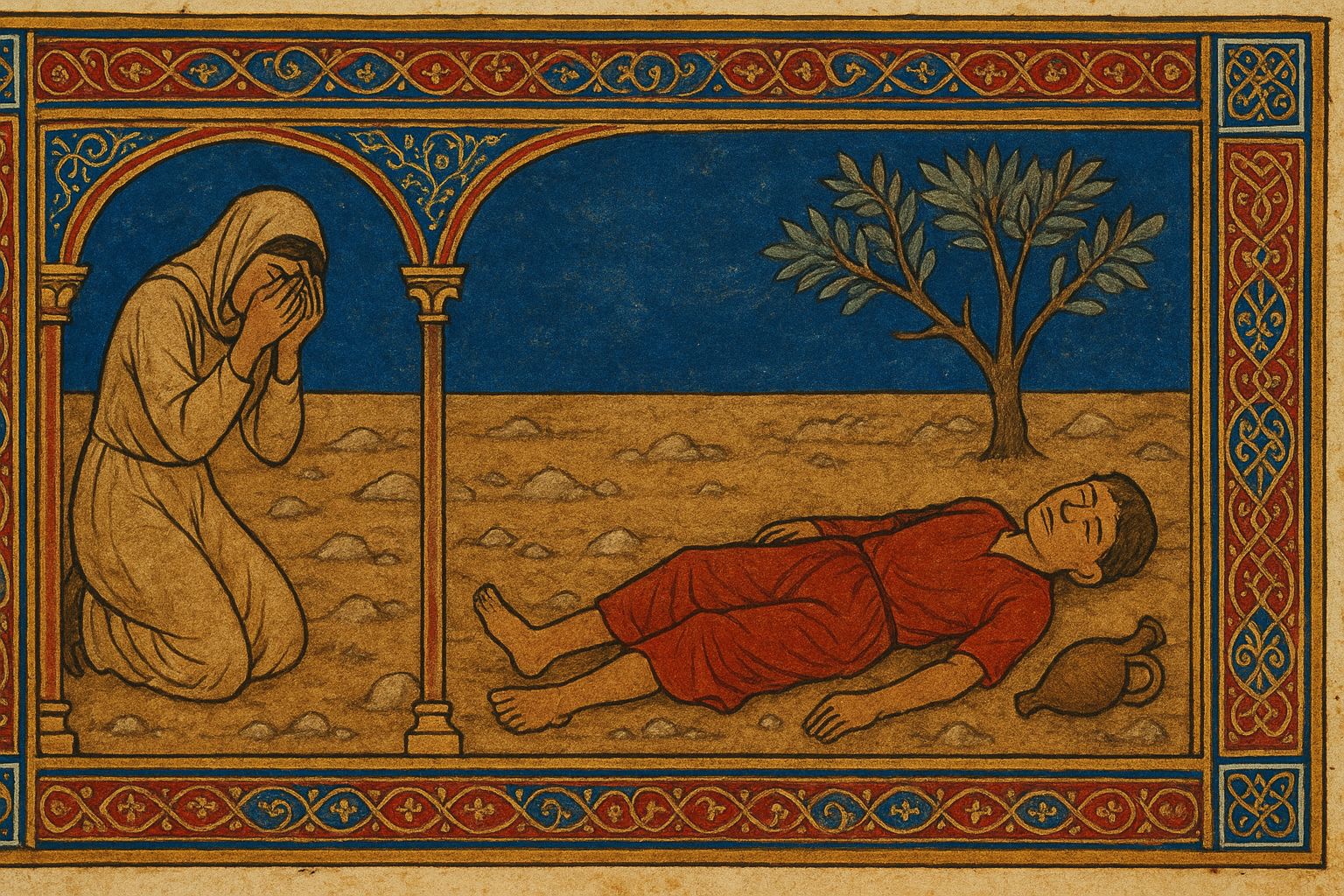
It was still dark when Abraham rose. The lamps in the women’s tent had long burned out; he moved by the gray under the eastern sky, and by feel. He found the bread Sarah had set out — three loaves, wrapped — and the skin of water, full and heavy as a child. He put both into a sling of cloth, stood a long moment with the bundle at his feet, and then went to wake Hagar.
She was awake already. He had not needed to say it; she had read it in his face yesterday when he came back from where he had walked alone, and again last night when he would not eat. The boy still slept, sprawled across her arm with his mouth open the way boys sleep. She lifted his head from her arm without waking him and rose.
Abraham stood in the doorway of the tent. He did not look at her. He looked at the boy. Ishmael was thirteen, fourteen now — taller than his mother, brown as a fired pot, his hair tangled with the morning. He was Abraham’s son. He had been Abraham’s son for fourteen years before the laughter in Sarah’s tent had settled into another son sleeping in another bed, and the household had begun to make its quiet count.
“Wake him,” Abraham said.
She woke him. The boy sat up, rubbed his face, looked at his father in the doorway and at his mother bending over the small bundle she was tying together. He did not ask. He had already understood something at the feast, at the weaning of his little brother, when Sarah had stopped laughing with her mouth and laughed only with her eyes, and her eyes had been on him.
Abraham himself bent and put the water-skin over Hagar’s shoulder. He had to reach to do it, and for a moment his face was very near hers. He did not speak. Then he stepped back and said to the boy, “Walk southward. Toward Beersheba. Stay with the wells where you can.”
The boy nodded.
“Father,” he said.
“I know,” said Abraham.
He gave each of them bread. He stood with his hand on the boy’s shoulder for one count, two counts, three. Then he took his hand away, and Hagar and Ishmael walked out of the camp into the gray, and the sky began to turn the color of a bruise and then the color of an apricot, and they did not look back, because Hagar had been a slave once and knew how to leave a place without looking back.
The wilderness of Beersheba is a country that does not love anyone. It is gray and tan and the color of an old bone. The shrubs grow apart from one another, as if they have agreed not to draw on each other’s water. The wadis are dry. The flies come up from the dust in clouds.
For one day they walked easily. The boy made jokes; Hagar made him drink twice from the skin and herself only once. They slept under an outcrop of stone, and the boy curled against her back as he had done when he was small, and she lay awake counting the stars to keep from counting other things.
The second day was hotter. The boy did not joke. They had eaten the bread; the skin of water was lighter than it should have been. By midday the heat lay on them like a hand.
She had thought she knew what to do. Walk to a well. Sell something. Beg. Find Egyptian travelers and speak Egyptian to them, and the language alone would buy them a meal. But the wilderness south of Beersheba does not have travelers in midsummer, and the wells were full of nothing or full of other peoples’ herdsmen who shouted them off, and by the third day the skin was empty.
The boy did not complain. That was what frightened her. He had stopped speaking. His lips were the color of ash. His eyes had begun to slide past her face without finding it.
She had been carrying him by then, her arm around his waist, his weight against her hip. He was too big to carry. She did it anyway. She walked, stopped, walked again. The sun climbed straight up the sky and stayed there. She found one shrub at last that threw a stripe of shadow on the ground, and she lowered him into it the way one lowers a wounded thing, easing the head down last.
She put the empty skin under his head. She straightened. She looked at him.
She walked away.
She walked perhaps the distance an arrow flies — that distance a boy his age could shoot, if he had a bow, which he did not; they had not brought it. Then she sat down with her back to him. She put her hands over her face.
Let me not see the death of the child.
She said it aloud because there was no one to say it to but herself and the wilderness and the God of Abraham, whom she did not entirely know, and from whom she did not exactly expect anything. She had spoken with him once before, by another spring, when she had been pregnant and running and afraid. He had told her to go back. She had gone back. She had borne the boy. She had named the boy. And what had come of it but this.
She wept. She did not weep beautifully; she wept like a woman whose throat is full of dust. The sound of it was not a wail but something dryer, smaller — an animal sound. She wept with her face in her hands so that she would not have to see her hands.
She did not hear the boy. The boy was the one heard. She would learn this afterward and would not understand it; she had been the one weeping. But it was the boy’s voice — perhaps a single sound he had made, perhaps only the breath of a body that has decided not yet to die — that reached the listening of the angel.
The angel called her by name.
Hagar.
It was not a voice from the sky. It was a voice as ordinary as a man speaking from the next room.
What aileth thee, Hagar? Fear not; for God hath heard the voice of the lad where he is. Arise, lift up the lad, and hold him in thine hand; for I will make him a great nation.
She lifted her face. She did not see anyone.
She stood. Her knees were stiff and her hands were numb, and she could not have said whether her eyes were open or shut, only that the world had gone very bright and very still.
And then she saw the well.
It had perhaps been there all along. Or it had not been there. She was never afterward able to say. It was a low ring of stones around a dark mouth in the ground, no further from her than a man can throw a stone, and she had not seen it. She walked to it. She knelt at the edge. She looked down and saw, far down, the bright disc of water with her own face in it — a face that was hers and not hers, the face of a slave woman of forty, worn, hollowed, alive.
She filled the skin. The water was cold. It came up out of the dark earth as if it had been waiting.
She brought it to the boy. She lifted his head into her lap. She wet his lips with her finger first, the way one wets the lips of an infant. He swallowed. She gave him a little more. Then she put the mouth of the skin against his mouth and let him drink — slowly, slowly — holding the back of his head with one hand, the way she had held it when he was new.
He drank. He opened his eyes. He looked at her.
“Mother,” he said.
She said nothing. She had no words. She drew his head to her shoulder and rocked him, and she kept rocking him after he had stopped needing to be rocked, because she needed it.
Afterward the boy grew. The wilderness, which does not love anyone, learned to leave him alone. He learned the wadis where the rains pool in spring, the shadows where the desert hares lie up in the noon, the angle at which a hawk turns when it has seen a thing on the ground. He made himself a bow of acacia wood and a string of the gut of a goat, and he could put an arrow into the eye of a melon at thirty paces. His mother watched him from the doorway of the tent they had pitched at last in the wilderness of Paran, and she thought sometimes — when he stood in the long evening light, drawing the bow against the orange sky — that he had grown taller than his father.
She found him a wife in time, out of the women of Egypt, the country she herself had not seen since she was a girl. She did not go back with the bride-train to fetch her; she sent for her. She had become a woman who waited at the door of a tent.
In the evenings, when the boy — the man — came in from the hills, he would sit by the fire and unstring his bow and lay it carefully across his knees. Hagar would bring him water in a clay cup. She would stand a moment with the cup in her hand before she gave it to him. The water in the cup would catch the firelight and shine.
Then she would put the cup in his hand and go to see about the bread.