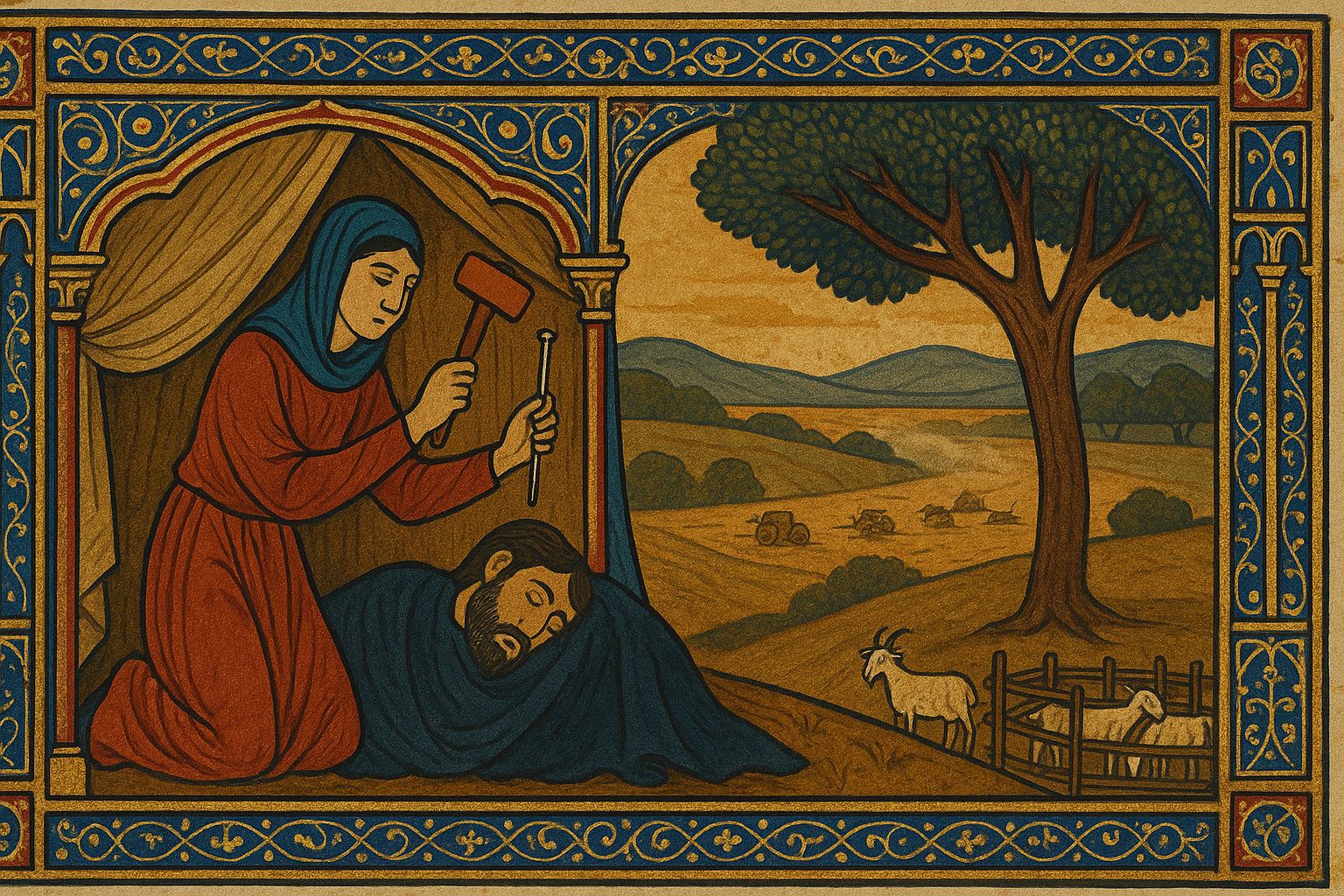
It was the hot hour after the rout. Below, in the valley of the Kishon, dust still hung in a low cloud where the chariots had wheeled and broken. The river was up with the spring rain. Iron wheels lay in the mud of it, and horses on their sides, and men face down where they had fallen reaching for the bank. The smell came up the slope on the wind, faint and sweet and wrong.
Jael was at the goat-pen mending a strap when she saw him.
A man, alone, on foot, climbing the path from the valley. He came not as a man walks but as a man pushes himself forward when his legs have ceased to be legs. He had no shield. His left arm hung. His tunic, which had once been good cloth, was dark down one side. As he came nearer she saw the embroidery at his collar and the silver pin at his shoulder and knew him for someone, though she had never seen his face.
She did not move. She watched him climb. He did not look up until he was almost at the pen, and then he looked at her with the look of an animal that has run too long.
“Peace,” she said.
He could not answer. His mouth worked.
She set down the strap and stepped from the pen and went to meet him on the path. The other tents stood lower down the slope, in a loose ring around the well; her own was set apart, by the great oak in Zaanannim, where Heber liked it for the shade. There was no one in earshot. Heber, her husband, was three days east with the herds. The boys had gone with him.
“Turn in, my lord,” she said. Turn in to me; fear not.
He looked at her, and his face changed, as if he had heard, far off, the first note of a familiar song. He let her take his good arm. He let her lead him to the tent.
Inside it was dark and the air was thick with the smell of goat hair and old smoke. She drew the flap closed behind them. She set him down on the rug by the central pole, and he went down without resistance, like a man who had been holding himself up only because no one had yet told him he could stop.
She covered him with a mantle of dark wool.
“Water,” he said. The word came out cracked. “A little water to drink. I am thirsty.”
She did not bring water. She went to where the milk-skin hung from the second pole and unstopped it and poured a bowl. The milk was cool from the morning. She brought it to him and held it for him while he drank, because his hand was shaking too much to hold the bowl himself. He drank in long swallows. Some of it ran into his beard. When he had finished she set the bowl aside and covered him again, drawing the wool up to his chin.
He lay back. His eyes closed and then opened. They did not focus on her.
“Stand in the door of the tent,” he said. “If any man come and inquire of thee, Is there any man here? — thou shalt say, No.”
“No,” she repeated softly, as one repeats a child’s lesson back to him.
He nodded. He closed his eyes.
She sat by him. She did not move. She listened to his breathing change. She watched his hand on the mantle uncurl, finger by finger. The chest rose and fell, rose and fell. Once he muttered something — a name, perhaps, or a command from some battle still being fought behind his eyes — and then he was quiet, and the quiet deepened into the slow heavy breathing of a man whose body had gone past its strength and now slept as the dead sleep.
She sat a long time.
She could hear, very faintly, the bleating of a goat down the slope, and a dog answering it once. The wind moved the tent-flap and let in a thin sword of light across his face. His face in sleep was younger than she had thought. He had a small scar at the corner of his mouth, white in the brown of his beard. A man’s face, no different from any other.
She had grown up on stories of Jabin’s chariots. Nine hundred chariots of iron, the women said in low voices when the children were not meant to hear, and at the head of them a man who took what he wanted from the villages of the north and left what he did not want broken. Twenty years. The women of Naphtali no longer sang at the wells. The roads were not used. People went by the byways. A girl in Kedesh whose name she still knew had been carried off and not returned.
This was the man.
The peace between Jabin and the house of Heber was a peace of tents pitched out of the way, of herds driven east when armies moved, of doors that did not open when riders passed in the night. It was the peace of small people who had learned to be invisible. It was not love.
She rose without sound.
The tent peg lay where it always lay, by the back of the tent, with the others, a length of iron forged for ground that did not yield easily. She took it in her left hand. It was cold. The hammer — the heavy one, the one for driving into rocky soil — lay beside the peg-bag. She took it in her right. The wood of the haft was worn smooth where Heber’s hand had held it a thousand times.
She came back to where he slept.
She knelt beside him. She set the point of the peg against his temple, where the hair was damp and the vein moved beneath the skin, and she paused there a moment with her two hands holding the iron and the wood. She could feel the small steady pulse against the iron point. She did not look at his face.
She did not pray. She did not curse him. She thought, very clearly, of nothing at all.
Then she swung.
The hammer came down once, with the full weight of her shoulder behind it, and the peg went in to its head, and on through, and into the earth beneath. His body jerked once. Then it was still. There was less blood than she had expected. The mantle caught most of it. His mouth was a little open. The hand she had watched uncurl lay open on the rug, palm up, as if he were waiting to be given something.
She sat back on her heels.
She set the hammer down beside her, very gently, as a woman sets down a sleeping child.
For a long time she did not move. Outside, the goat had stopped bleating. The wind had dropped. The light through the tent-flap had moved a hand’s-breadth across the rug. Somewhere far off a kite cried, and circled, and cried again.
At last she stood. She wiped her palms on her skirt — twice, and then a third time, though there was nothing on them. She straightened the mantle so that it covered him to the chest. She did not look again at his face.
She went out into the sun.
The sun was lower now and the dust in the valley had thinned. The smell from the river was less. She walked a little way down the path, not far, only as far as the goat-pen, and there she stood with one hand on the post and waited.
She did not wait long.
He came up the path the way Sisera had come, but he came differently. He came as a man comes who is still being carried by the thing inside him that fights — a tall man, dust to his knees, a sword loose in his hand, his breath hard. Behind him, lower down, she saw the first of his men cresting the rise. He looked left and right along the line of tents. He looked at her.
“Come,” she said. “Come, and I will shew thee the man whom thou seekest.”
He stared at her. He did not understand. Then he understood, and his face did a thing she did not know how to name — something between hunger and grief, and under both of them a kind of shame.
He followed her.
She held the flap aside for him. He had to stoop to enter. Inside the dimness took him a moment, and she heard his breath catch when his eyes found the rug and what lay on it, and the iron in the temple, and the small dark place on the wool where the blood had pooled and dried.
He went down on one knee beside the body. He did not touch it. He looked at the peg a long time, at the angle of it, at the way it had gone through and into the ground beneath, fastening the man to the earth as a tent is fastened. He breathed out, slowly, through his teeth.
He did not look at her.
After a while he stood. He went out of the tent without speaking. She heard him outside, giving an order to one of his men in a voice gone hoarse. She heard a runner sent down the slope. She heard the runner’s feet on the stones, fading.
She stayed in the doorway with her hand on the flap.
The sun was going. The shadow of the great oak in Zaanannim had lengthened across the goat-pen and reached the corner of her tent. Down in the valley a bird called once and was answered. The air was beginning to cool.
Inside the tent the man lay as he had lain. Outside, the runner was gone, and the captain stood with his back to her, looking down toward the river, and the first stars were not yet out.
She closed the tent-flap behind her and went to bring in the goats.