The famine came in the third year as a kind of slow argument the land was having with the sky. The first year men still spoke of it as bad luck, the second year as a hard season, but by the third the wells went sour and the children sat in the shade with their mouths open like fledglings, and the elders went up to the king at Jerusalem because there was no one else to go to.
David inquired of the LORD. He did this in the way a man goes to look for a thing he has already half-decided he will find. The answer came back in the dry voice that prophets carry: It is for Saul, and for his bloody house, because he slew the Gibeonites.
Saul had been dead a long time. Long enough that his name in the city was a thing said carefully, like the name of a fever someone in the family had survived. But there were still Gibeonites in the hills west of Jerusalem, woodcutters and water-drawers, a remnant of the old Amorite covenant that Joshua had sworn under the oaks. Saul in his zeal for Israel had hunted them. Whether he had hunted them with reason or with the long appetite of a man who needed enemies, no one now living could quite say.
The king sent for them. They came in by the gate at dusk, seven of them, dust-colored, their beards uncut. They would not sit on the cushions. They stood in the cool of the king’s hall and looked at the lamps as though they had not seen lamps in some time.
“What shall I do for you?” David said. “Wherewith shall I make the atonement, that ye may bless the inheritance of the LORD?”
The eldest of them was a man whose lower lip had been split long ago and never healed straight. He spoke through it slowly.
“It is not silver and gold we want of Saul, nor of his house. Neither for us shalt thou kill any man in Israel.”
“Speak then,” David said.
“The man that consumed us, and devised against us — let seven men of his sons be delivered unto us, and we will hang them up unto the LORD in Gibeah of Saul, the chosen of the LORD.”
David sat with his hand on his knee and did not speak for a while. Outside someone was bringing in a goat that had broken its leg in the dry stones, and the goat was crying. At last he said, “I will give them.”
He spared Mephibosheth, the son of Jonathan, for the oath he had sworn to Jonathan under the new moon long ago. The other seven he gave. Two of them were the sons of Rizpah the daughter of Aiah, who had been Saul’s concubine. Five were the sons of Merab, Saul’s daughter, whom she had borne to Adriel the Meholathite. They were taken at night so that the city would not gather. They were taken quietly, the way one takes lambs at the back of the fold so the others will not start.
Rizpah was in the women’s quarters at Gibeah when they came. She was not young anymore. Her hair had gone the color of old iron, and there was a place at her temple where it had gone white in a streak after Ish-bosheth was killed in his bed. She heard the men in the courtyard and she heard her sons’ voices, first sleepy and then changing, and then she heard Armoni call out mother once, only once, and after that the sound of feet going away on the stones.
She did not weep that night. She sat upright on the floor with her hands flat against the dirt as though she were holding the earth down.
In the morning she went out.
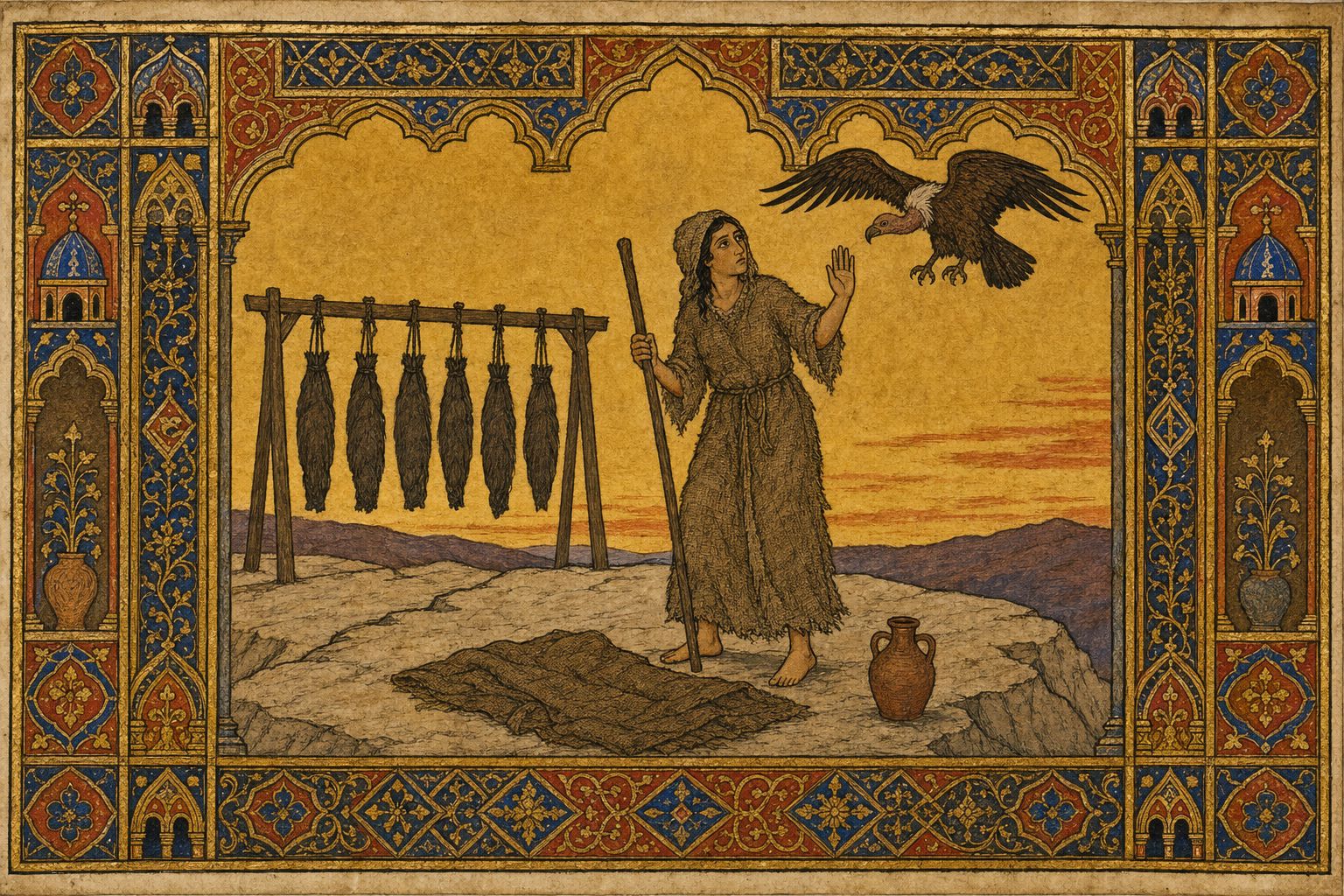
The hill of Gibeah is a flat-topped rise of pale rock that the wind has been polishing since the world began. On the northern shoulder of it the Gibeonites had set their frame: seven beams, lashed two and two and one across, the way a man builds a thing he means to last only a season. By the time Rizpah came up the path the bodies were already there. Vultures stood on the crossbars with their shoulders hunched. The morning light was very clean.
She walked the line of them once. She did not touch them. She walked it again, and at the third pass she stopped before the smaller two on the eastern end and stood a long while with her face tilted up. The wind moved the hair at her sons’ feet. There was nothing in their faces that she had not seen before in her own.
She had brought a roll of sackcloth on her shoulder. She unrolled it on the flat rock at the foot of the frame and sat down on it. Then she lay down on it. Then she stood again and took the long juniper staff she had carried up and went and beat the vultures off the crossbeams. They lifted heavily and circled and came back, and she beat them off again. By midday she had made a kind of rhythm of it. Up. Down. Up.
The barley harvest was just beginning. In the valleys you could see the cutters bent over the rows like small dark commas. The Gibeonites had asked for the seven at the beginning of harvest because that was the season when Saul had first hunted them, and the symmetry pleased them. Rizpah did not know about the symmetry. She knew only that the sun came up earlier each day now and went down later, and that the hours she had to keep were lengthening.
The first night she did not sleep. She kept a small fire of thornbush at the foot of the rock to keep the jackals off, and when she heard them coughing in the wadi she stood up with the staff in both hands and walked the line. The bones of her feet were already speaking to her.
In the second week the smell came. She had known it would come. She had buried her father once, in a hot summer, and she remembered. She tied a strip of cloth across her face and after a few days she stopped tying it because it did not help and because she did not want anything between her and them.
Word went down to Jerusalem in the third week. The concubine of Saul is on the rock at Gibeah. She drives the birds off. She will not come down.
David was told this in the cool of the evening as he walked on the roof. He stopped walking. He looked north toward the hills where Gibeah lay, although Gibeah could not be seen from there. He said nothing to the man who had told him. He went on walking.
The barley was cut. The wheat began to ripen. In the towns the people watched the sky for the first cloud and there was no cloud. The famine had not lifted. Some said the LORD was waiting for the bones to be taken down. Some said the LORD was waiting for something else and would not say what.
Rizpah grew thin. Her hands cracked. The streak of white at her temple spread until the whole side of her head was white. The skin of her face went the color of the rock she sat on. Children from the village came up and watched her from a little distance and went away again. An old woman brought her a jar of water and set it down at the edge of the path without speaking, and went away. The next morning Rizpah found a second jar there, and a flat loaf wrapped in a cloth.
When the rains came they came at night. She heard them first as a sound in the stones, a clicking, and then the smell of wet dust rose all around her, and then the rain itself, on her face, on the sackcloth, on the dark shapes above her. She stood up in it. She put her hands out flat with the palms up. She did not shout or cry. She stood there with her palms up until the rain stopped, which was just before dawn.
The runner from Gibeah reached Jerusalem at the third hour. The king was at his meal. The runner spoke and the king put down the bread he was holding and looked at it on the cloth as though it were something he had never seen before.
“Send to Jabesh-gilead,” he said. “The bones of Saul and Jonathan are there, that the men of Jabesh stole away from the street of Beth-shan when the Philistines hanged them. Bring them up. Bring them all up. Bring these seven also.”
They came for her at evening. She had been on the rock through the barley harvest and the wheat harvest and into the time of the early rains — from April, the men of the villages reckoned, into October. She was sitting when they came. The staff lay across her knees. She did not stand for them.
The captain of David’s men was a young man with his beard newly trimmed. He knelt on the rock at the edge of her sackcloth and waited until she looked at him.
“The king has sent us to take them down,” he said. “And to bury them in the sepulchre of Kish their father, in Zela, in the country of Benjamin. The king has sent also to Jabesh-gilead for the bones of Saul and of Jonathan his son. They will lie all together.”
She looked at him for a long time. Her eyes were very pale in the dark of her face.
“Take them,” she said.
They cut the lashings. They took the bodies down with great care, two men to each, and wrapped them in linen the king had sent. The linen was very white against the rock. Rizpah stood up at last, slowly, holding the staff. She watched them carry her sons down the path.
When the last of them had gone she rolled up the sackcloth. She did it carefully, as one folds a garment that has been worn a long time and will not be worn again. She tucked it under her arm. She picked up the empty water-jar.
At the head of the path she stopped and looked back once at the rock. The frame was still standing. The wind moved across the place where she had lain. A single vulture, late, circled once over the empty crossbars and went away westward toward the sea.
She went down the path into the gathering rain.