The grey was on the hills when he rose, and the air had not yet warmed. Balaam son of Beor stood in the courtyard while a boy fetched the bridle, and he looked at the road that led south, toward the country of Moab, and he did not look at it twice. His mind was already moving along it.
He had refused once. The princes of Moab had come the first time, in their bright cloaks, with their messengers’ staves and their bag of gifts, and he had told them no, and they had returned to Balak. Then they had come again, more of them this time, and more honorable, and the gifts had been heavier. He had told them to wait the night. In the night a word had come and the word had said, Go with them. So in the grey he was going.
The boy brought the donkey. She was an old beast, low and patient, dark in her hindquarters and pale on her belly, and she stood while the saddlecloth was laid across her and the girth drawn under. Her ears moved at his step. He had ridden her since he was a man not much older than the boy. She knew his weight before he was on her. He swung up.
Two servants mounted behind him and they went out into the road.
The sun lifted above the hills and the dust on the road began to glow. The vines on the right were heavy with the small bunches that had not yet darkened, and on the left the barley stood in pale stretches that ran to the ridge. He rode in silence. The two servants spoke now and then behind him about nothing — the heat of the day to come, a goat that had wandered, the price of oil in Pethor. He did not hear them. He was thinking of the words he would say to Balak. He was thinking of the look on the king’s face when the words were said. He was thinking of what was honorable and what was much.
The donkey stopped.
She had not stopped for anything before, not for the bend of the road nor the rise. She stood in the middle of the path with her head low, and her ears were back, and she did not move. Then, of her own, she turned and went off the road into the field.
He pulled the rein. She did not turn. She walked a little way into the standing grain and stood again.
“What is wrong with the beast?” said one of the servants behind him, and Balaam did not answer. He kicked her. He brought down the heel of his sandal on her flank, and she shuddered and walked a few steps further from the road. He brought the staff down across her neck. She came back to the road slowly, as if pulling a weight, and went on.
The vineyards closed in. The walls along the path were of dry stone, gathered out of the field at the time of clearing, and they came up to a man’s waist, and the path between them was narrow enough that the donkey’s flanks brushed the stones on either side. The dust here lay deeper, because the wind could not move it. He rode with his head a little ducked because of a fig that leaned over from the wall.
The donkey stopped a second time. He felt her gather. Then she pressed sideways against the right-hand wall, and his foot, his sandalled foot, was caught between her flank and the stone, and the stone was warm and rough and his foot was crushed against it, and he cried out.
The pain ran up his leg into his hip. He felt the skin tear. He brought the staff down on her shoulder, hard, and again, and she made the sound that asses make when they are hurt, that strange high choked cry, and she pulled forward, and he was free, and they came out of the narrow place and on to where the path widened, and he was breathing through his teeth.
He looked back at the wall. There was blood on the stone. It was his.
The servants had stopped some distance behind. He did not look at their faces.
The path narrowed again. Here there was a place where two banks of earth came close together and the way between them was scarcely wider than the donkey. Beyond it the road opened to the plain. He gathered the rein and urged her forward.
She walked into the narrow place and stopped.
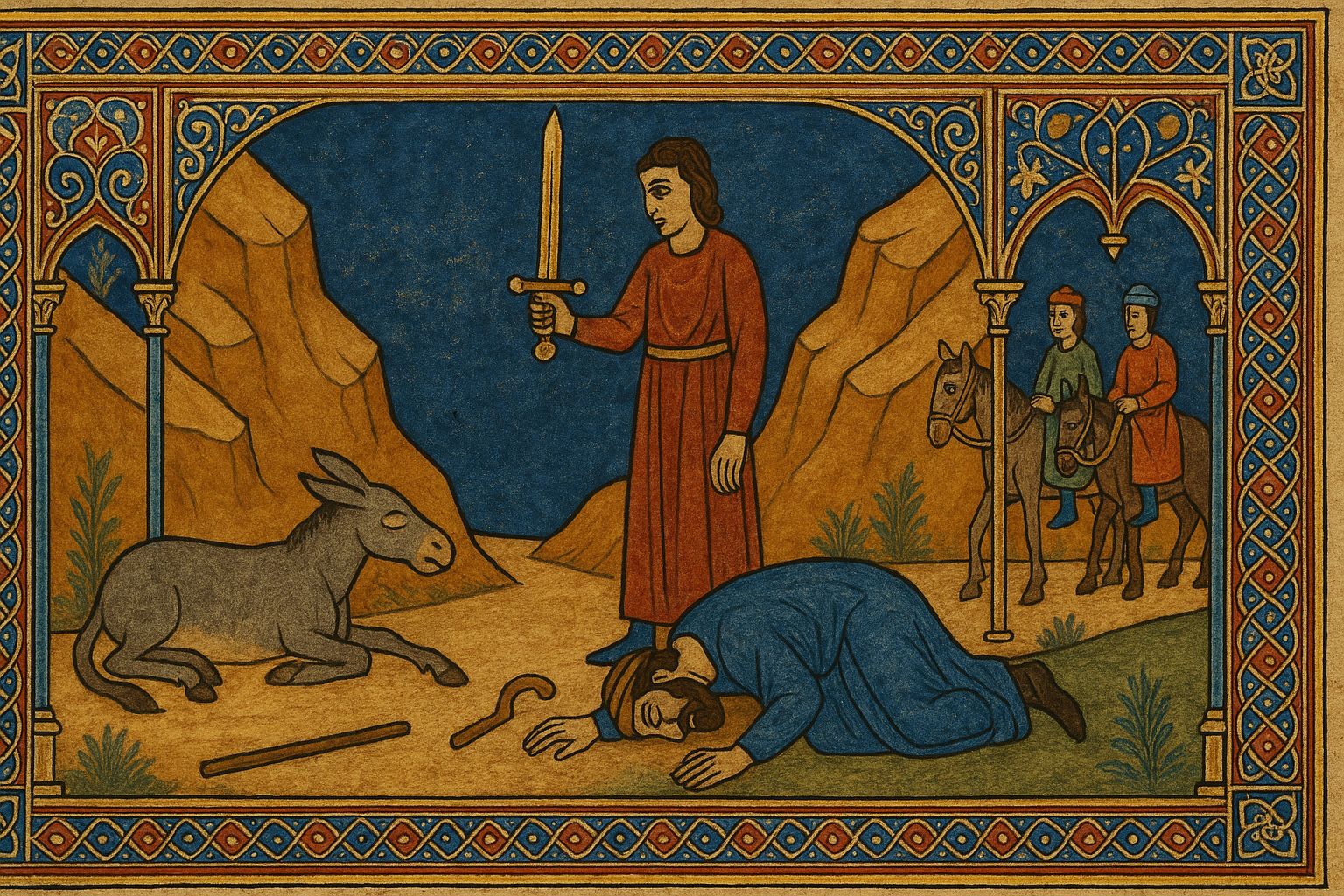
He kicked her. She did not move. He struck her with the staff across the haunches and she folded under him. Her front legs buckled and her back legs buckled and she went down to the ground, and he was sitting astride a beast that was lying flat in the dust of the path, and his crushed foot was on the ground beside her, and the pain came back into it.
He stood up off her. He took the staff in both hands. He brought it down on her ribs and on her neck and on her flank, and the blows fell heavy, and he was breathing in great breaths, and the heat of the morning was on his face, and his foot throbbed in time with the blows, and the donkey lay still and took them.
Then she spoke.
He did not, at first, understand that she had spoken. He thought it was the sound of his own breath. Then he heard the words as the words of a tongue he knew, and the words came up out of her chest, and her mouth moved.
What have I done unto thee, that thou hast smitten me these three times?
He stopped with the staff above his head.
He looked at her. Her eye was rolled up toward him. The white of it was streaked with red. There was foam on her lip. She lay in the dust and she had spoken.
A man, in such a moment, may go mad. A man may run. A man may drop his staff and sit in the road and weep. Balaam did none of these things. He had spent his life listening for voices that came out of places where voices ought not to come. He had heard them in the smoke of altars and in the cast of bones and in the flight of birds and in the night when sleep was thin. He answered her.
“Because thou hast mocked me,” he said. His voice came out small in his throat. “I would there were a sword in mine hand, for now would I kill thee.”
She answered him. Am not I thine ass, upon which thou hast ridden ever since I was thine unto this day? Was I ever wont to do so unto thee?
He looked at the road ahead. He looked at the narrow place where the banks came close. He looked at the wall behind him where his blood had marked the stone. He looked at the field beyond, where she had first turned aside.
“Nay,” he said.
Then his eyes were opened.
It was not as a door opens, nor as a curtain. It was as if a film, of which he had not known, were drawn back from the air itself. The air between the banks of earth was no longer air. There stood, in the narrow place, a man, and the man was tall, and in his hand was a sword, and the sword was drawn, and the sword caught the morning light.
Balaam dropped the staff. His knees gave under him. He went down to the ground on his face beside the donkey, and the dust was in his mouth.
Wherefore hast thou smitten thine ass these three times? said the voice above him. Behold, I went out to withstand thee, because thy way is perverse before me. And the ass saw me, and turned from me these three times: unless she had turned from me, surely now also I had slain thee, and saved her alive.
He spoke into the ground. He did not lift his head. “I have sinned,” he said, “for I knew not that thou stoodest in the way against me. Now therefore, if it displease thee, I will get me back again.”
There was a silence. He could hear the donkey breathing. He could hear his own heart in the side of his face that lay against the road. He waited.
Go with the men, said the voice, but only the word that I shall speak unto thee, that thou shalt speak.
He lay a little longer. Then he heard nothing, and the heat of the air came back, and the sound of an insect somewhere in the dry grass.
He raised his head.
The path was empty. The narrow place was a narrow place. The banks of earth were banks of earth. There was nothing in the air between them.
He got to his hands. He got to his knees. He stood up. His foot would not bear him at first, and he leaned on the staff. The donkey was still on the ground. He went to her head. He laid his hand on her cheek. Her eye looked at him as it had always looked at him. She did not speak.
After a while she gathered her legs under her and rose. She shook the dust from her sides. She stood waiting.
He climbed up onto her back. He did not strike her. He did not speak to her. He sat on her for a long moment in the narrow place and looked between her ears at the road ahead, at the plain that opened beyond, at the country of Moab lying pale in the distance under the climbing sun.
Behind him one of the servants coughed.
The donkey began to walk.