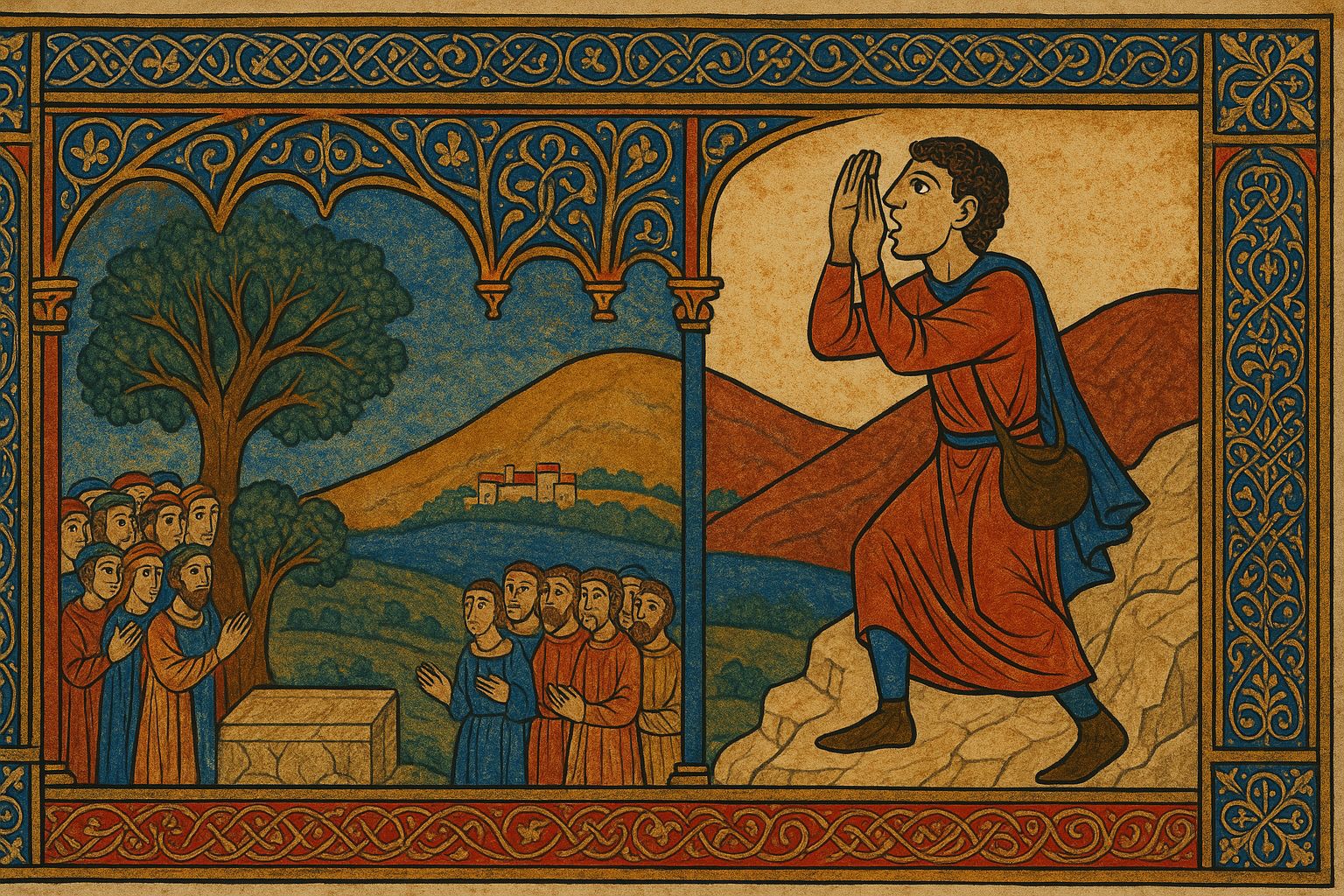
The smell of blood was still in his clothes when he reached the high places.
He had hidden three days in a sheepfold north of Ophrah, listening to dogs argue over what was left on the stone. Now the wind off Ebal pushed at his back and he climbed, half-crawling where the path failed, the goatskin water-bag knocking against his ribs. His sandals were torn through at the heel.
Below him the basin of Shechem opened like a bowl. The town lay in its hollow between the two mountains — Ebal to the north, where the curses had once been spoken, and Gerizim under his hands and knees now, where the blessings had been. He kept climbing until the houses were small and he could see the threshing floors and the great terebinth where the people gathered, the standing stone at its foot. A crowd had massed there. He could hear them without hearing words — the hum a herd makes when something is being decided.
He sat down on a shelf of pale rock and breathed.
He was the youngest of seventy and one. Last summer the seventy had stood together at Ophrah for their father’s threshing, and he had counted them and lost count and started again, laughing because Eliel had cuffed him for losing count. Three days ago the seventy had been laid down on a single stone — one by one, like sheaves, and slaughtered like sheaves, by men hired with silver out of the treasury of Baal-berith. He had watched from a long way off because Tirzah, his father’s serving woman, had pushed him into the standing barley and told him to be still or be dead.
He had been still. He had been dead in his stillness. Now he was here.
Below, at the great stone by the terebinth — the stone that Joshua had set up so that no man would lie before the Lord — they were anointing his brother king. Abimelech, son of Gideon, son of the concubine in Shechem. The men of the city stood in their coloured robes and the herders came in from the slopes, and the elders sat on the bench by the gate, and someone was breaking bread.
Jotham stood up.
He cupped his hands to either side of his mouth, the way a shepherd does when he calls across a wadi, and he drew breath until his ribs ached against his belt. The morning air carried sound the way water carries oil — far, and unbroken.
Hearken unto me, he shouted, ye men of Shechem, that God may hearken unto you.
The hum below faltered. Faces turned. He saw them turn as a flock turns — slowly, then all at once. A child pointed. A man in a red mantle shaded his eyes.
He had thought all the way up the mountain about what he would say. He was a young man and not a speaker, and he had no army and no friends left living, and he had only his voice and the height of the mountain and the morning. He had thought of curses. He had thought of his brothers’ names, all seventy, and how he might call them down one after another like rain. Standing now with his hands at his mouth and the wind cold on his neck, he found instead that what came was a tale his father had told him once, sitting on the lip of a winepress in the dusk. A tale about trees.
The trees went forth on a time to anoint a king over them, he called down. His voice cracked. He swallowed and tried again, lower. The trees went forth to anoint a king over them; and they said unto the olive tree, Reign thou over us.
He had their stillness now. Even the goats on the next slope had stopped tearing at the thorns.
But the olive tree said unto them, Should I leave my fatness, wherewith by me they honour God and man, and go to be promoted over the trees?
He saw the elders by the gate lean forward. He saw the man in the red mantle take a half-step toward the slope, then stop.
And the trees said to the fig tree, Come thou, and reign over us. He let it hang a moment. But the fig tree said unto them, Should I forsake my sweetness, and my good fruit, and go to be promoted over the trees?
The wind moved in the terebinths around him. He could smell the leaves, and the resin where someone had cut a branch for cooking-wood, and the goat-smell of his own clothes, and the older smell underneath that, the smell that had been in his nose for three days and that he could not get out of his nose.
Then said the trees unto the vine, Come thou, and reign over us. And the vine said unto them, Should I leave my wine, which cheereth God and man, and go to be promoted over the trees?
He saw a man among the elders rise. Another caught his arm and pulled him back to the bench. Jotham watched the small struggle and did not pause.
Then said all the trees unto the bramble—
He paused now, deliberately. He had to. Far down the long slope, two men separated themselves from the gathering and began to climb in his direction. They moved without haste yet. They knew the mountain went up a long way.
Come thou, and reign over us.
The two men were starting to climb in earnest. He saw a third join them. He filled his lungs.
And the bramble said unto the trees — and here he heard his own voice take on something he had not known he had in him, a cadence his father had used when he had finished with patience — If in truth ye anoint me king over you, then come and put your trust in my shadow.
A laugh broke out of him, sharp and short. He had not meant to laugh. He felt it leave him and was not sorry.
And if not, he called down, let fire come out of the bramble, and devour the cedars of Lebanon.
He let the words walk down the slope and into the crowd and through the streets and across the threshing floors and into the open mouth of the temple of Baal-berith.
Then he spoke without shouting, because they were listening now, and he could; his voice carried the way voices carry across still water.
Now therefore, if ye have done truly and sincerely, in that ye have made Abimelech king, and if ye have dealt well with Jerubbaal and his house, and have done unto him according to the deserving of his hands — and here his voice caught, and he forced it past — for my father fought for you, and adventured his life far, and delivered you out of the hand of Midian: and ye are risen up against my father’s house this day, and have slain his sons, threescore and ten persons, upon one stone, and have made Abimelech, the son of his maidservant, king over the men of Shechem, because he is your brother —
He had to stop. The slope held his words and gave them back small and doubled, and he could hear his own voice coming back at him from the rocks like another man calling, and it shook him. He held the goatskin against his side and breathed.
— if ye then have dealt truly and sincerely with Jerubbaal and with his house this day, then rejoice ye in Abimelech, and let him also rejoice in you. But if not, let fire come out from Abimelech, and devour the men of Shechem, and the house of Millo; and let fire come out from the men of Shechem, and from the house of Millo, and devour Abimelech.
The men climbing the slope were close enough now that he could see one of them carried a short sword loose against his thigh. They were not hurrying. The mountain was theirs and they knew its faces.
He turned and ran.
He went down the back of Gerizim, the side away from the basin, where the rock falls in dry steps and a man can break an ankle in a moment if he is not careful, and he was not careful. He ran with the wind in his ears and the sound of his own breath knocking inside his chest like a loose stone in a jar. He fell once and tore his palm on the limestone and tasted dust in the back of his mouth. He did not stop.
When he was below the line where the terebinths gave way to scrub, he looked back. The mountain showed him nothing. Only the brown shoulder of it against the morning, and a single hawk turning on the air above where the assembly had been.
He kept going. East, and then south, by the wadis, away from the road. He would go to Beer; his mother had cousins in Beer. He would not stay long. Wherever the bramble’s fire went, it would come looking for him.
By evening he was in a country of small hills he did not know. He drank from the goatskin and found it almost empty. He sat down with his back to a warm stone and waited for the shaking in his hands to ease.
A jackal called somewhere off in the dusk, and another answered, and then there was the sound of nothing — the long sound the hills make after sundown, when the day has finished saying what it had to say. He listened to it until the first stars came out over the ridge. Then he closed his eyes, and did not sleep.