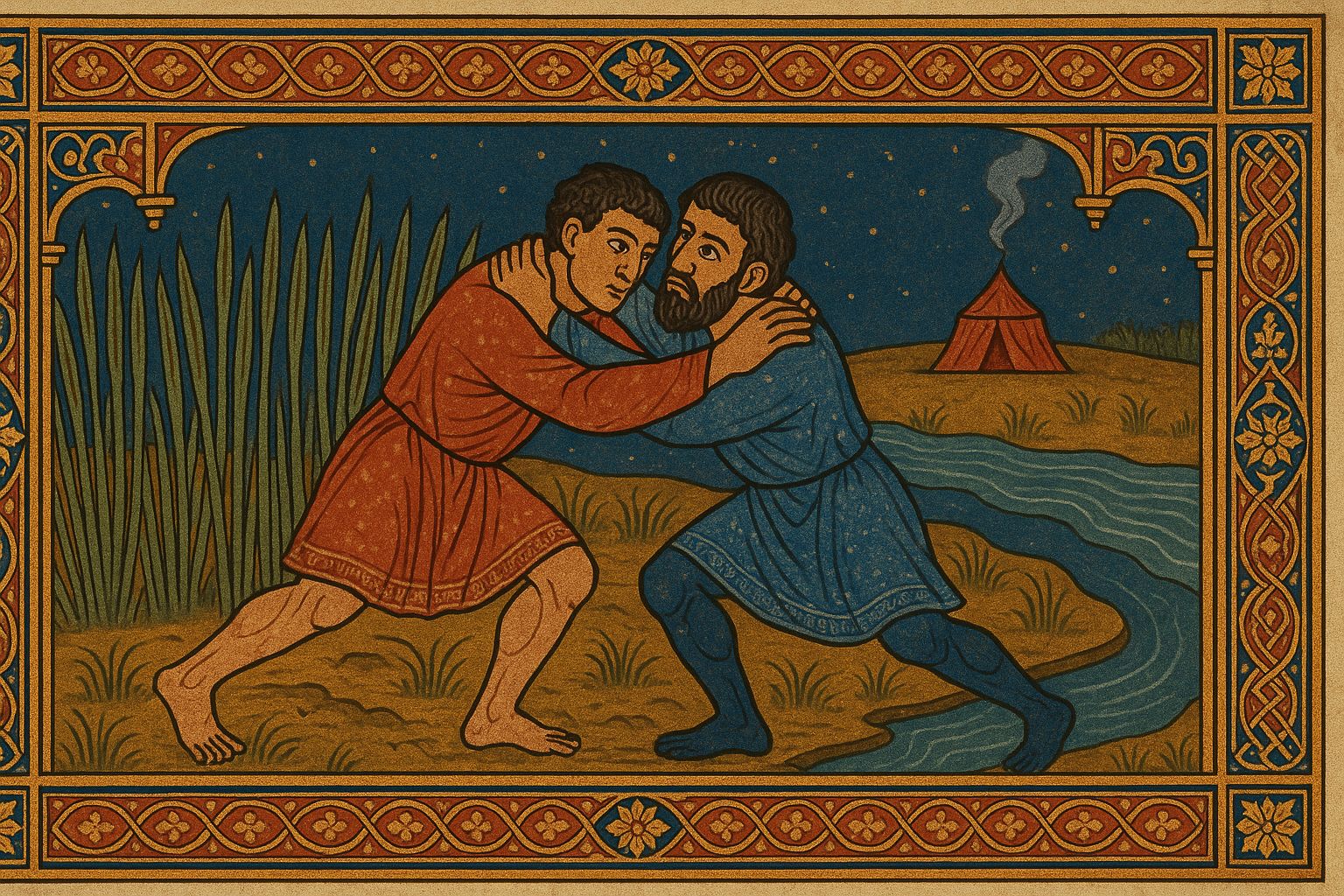
It was the deep hour before any bird stirred, the hour the herdsmen call the cold watch, and Jacob had been sleepless for two nights. He sat on a stone above the ford and watched the water move below him, dull silver beneath a moon already past full. The Jabbok ran low here and lay wide between its banks, no more than knee-deep where the herd had been crossing all evening.
He had counted the goats himself as they went over. Two hundred she-goats and twenty he-goats. Two hundred ewes and twenty rams. Thirty milch camels with their colts. Forty kine and ten bulls. Twenty she-asses and ten foals. The men had driven them in three companies, with a space of pasture between each, so that whoever came first to Esau would say: a present from thy servant Jacob unto my lord Esau; and, behold, also he is behind us. He had rehearsed the words in his own mouth as he counted.
Now the goods were across, and the servants, and the camels with the women rocking high among the bundles. Last he had taken Leah by the hand, and Rachel, and the two handmaids, and the eleven sons; he had gone before each in turn into the cold water, and the little ones had clung to his neck, and Joseph had not let go even on the far side until Bilhah lifted him away. Then Jacob had recrossed the ford alone, the chill lifting up his bones, and climbed back to the stone where he now sat.
Tomorrow, when the sun was up, his brother would come. Esau, with four hundred men. He had said it aloud at noon and he said it aloud again now, to hear how the number sat in the air. Four hundred men. Twenty years he had not heard the voice of that brother. Twenty years since the savor of that hunter’s stew, since the goat-skins on his hands, since his father had shaken in the tent and said, the voice is Jacob’s voice, but the hands are the hands of Esau. The blessing he had carried away in his mouth that day had bought him this present hour: the ford, and the camp on the far side, and four hundred men coming down from Seir.
He had prayed in the evening. He had prayed lying with his face to the ground among the tamarisks, and the prayer had not eased him. I am not worthy of the least of all the mercies, and of all the truth, which thou hast shewed unto thy servant; for with my staff I passed over this Jordan; and now I am become two bands. Even as he said it he had heard his own voice as a stranger’s, and the words had gone up into the dark like smoke that finds no roof.
He stood and walked down to the bank, partly to feel his legs again and partly because he could not bear sitting. The reeds came to his thigh. He stepped in among them.
The man came out of the reeds.
Jacob did not see him come. He felt the hand at his shoulder before he heard the breath, and by then the other hand was already at his belt, and the body of the stranger was against his own with the weight of a man who had decided. Jacob’s first thought, even as he twisted, was that this was one of Esau’s, sent ahead in the night to take him. He braced his feet in the mud and threw his weight back and got an arm around the other’s neck.
They went down together into the wet grass at the river’s edge.
The stranger was strong. Jacob was strong too — he had wrestled his cousins at the well in Haran, he had broken the stone from the well’s mouth at one heave when four men had lain against it — and he found at once that this man did not yield as men yielded. They rolled and the reeds broke under them and the water came up cold around Jacob’s hip and he heaved them both back onto the bank. He could not see the face. He could feel the beard against his cheek and smell nothing — no sweat, no oil, no wine, no smoke of any fire — and the absence of a smell was the first thing that frightened him.
He tried to pin the arms. The arms slipped and were behind him and his own breath went out. He tried for the legs. The legs were not where his hands expected them. Twice he had the man bent backward across his knee, and twice the man came up again under him as if he had not been bent at all. Jacob’s mouth filled with the taste of iron. His hair was wet, his beard was wet, the linen at his back was torn through, and still neither of them spoke.
The hours did not move the way hours move. The moon went down behind the hills of Gilead and the dark deepened and the cold came up out of the river and got into the marrow of his hands, and still they wrestled. He thought once, with a clarity he did not understand, that he had been wrestling this man all his life. He thought of Esau’s heel in his fist at the birth, the heel he had been pulled into the world holding, the heel that had named him: one who takes by the heel, supplanter. He thought of the lentils in the bowl, red and steaming, and his brother coming in faint from the hunt. He thought of Laban, and the changed wages, and the speckled and the spotted, and the rods peeled at the troughs, and how he had outrun even his uncle in the end. He had taken every man he had ever wrestled. He could not take this one.
A grayness began at the rim of the world.
The stranger seemed to know it before Jacob did. There was a small movement, no more than a shifting of the weight, and then the man’s hand was at Jacob’s hip, low and inside, and Jacob felt the joint go. It did not break. It came out from where it lived, with a sound he heard inside his own body, and his leg below the hip was no longer his leg but a thing he was dragging.
He did not let go.
He had been about to. He had been about to fall away into the reeds and be done. But when the hip went and the pain came up into his belly like a second man, something in him took hold instead, and he closed both his arms around the stranger and put his weight against him and held on.
Let me go, the man said. The voice was very near his ear. For the day breaketh.
The light was coming. He could see, now, the water moving past them, and the shapes of the reeds, and the dark of the hills beyond the camp where his children slept.
I will not let thee go, Jacob said, except thou bless me.
He heard his own voice as if it belonged to a man at a great distance. He did not know what he meant by bless. He did not know what he was holding. He knew only that he had spent his life taking blessings out of the hands of others and that he could not let this one cross the river without him.
The man was still a moment.
What is thy name?
Jacob.
Thy name shall be called no more Jacob, but Israel: for thou hast striven with God and with men, and hast prevailed.
Jacob’s mouth opened and the answer was already in it before he knew he meant to ask. Tell me, I pray thee, thy name.
The stranger did not answer. The arms that had been against him loosened. There was, instead of an answer, the press of a hand on the crown of his head — heavy, and warm, and brief — and then the weight against him was gone, and Jacob was holding the cold air, and the reeds where the man had stood were moving as reeds move when nothing is in them.
He sat down in the mud.
The light came on slowly. It came first as a paleness behind the hills, and then as a band of color above them, and then as a brightness that went out across the valley and laid itself on the river and on the broken reeds and on his own torn hands. He looked at his hands. They were the hands of a man, ordinary and bruised, with mud under the nails. He looked at his hip. He could not see anything there but the wet linen.
He tried to stand. His leg would not bear him. He went over sideways into the reeds and lay there a moment, and laughed once, a laugh that was not far from weeping, and then put his good leg under him and pushed himself up. He could walk if he leaned. He could limp.
He stood at the edge of the ford.
On the far bank a thread of smoke was going up from the morning fire. He could see the small shape of one of the boys — Reuben, by the height — moving among the tents. He could see the camels lying with their heads turned toward the east. Beyond the camp the road came down out of the hills, the road by which his brother would come.
He named the place Peniel. He said the name aloud, into the new light, and his voice went out across the water without echo. I have seen God face to face, and my life is preserved.
Then he stepped into the river.
The cold took his bad leg as a kindness, holding it up. He went across slowly, leaning on nothing. The sun, just clearing the hill behind him, came over his shoulder and laid his shadow long upon the water in front of him, a thin shadow that limped, and the shadow reached the far bank before he did.