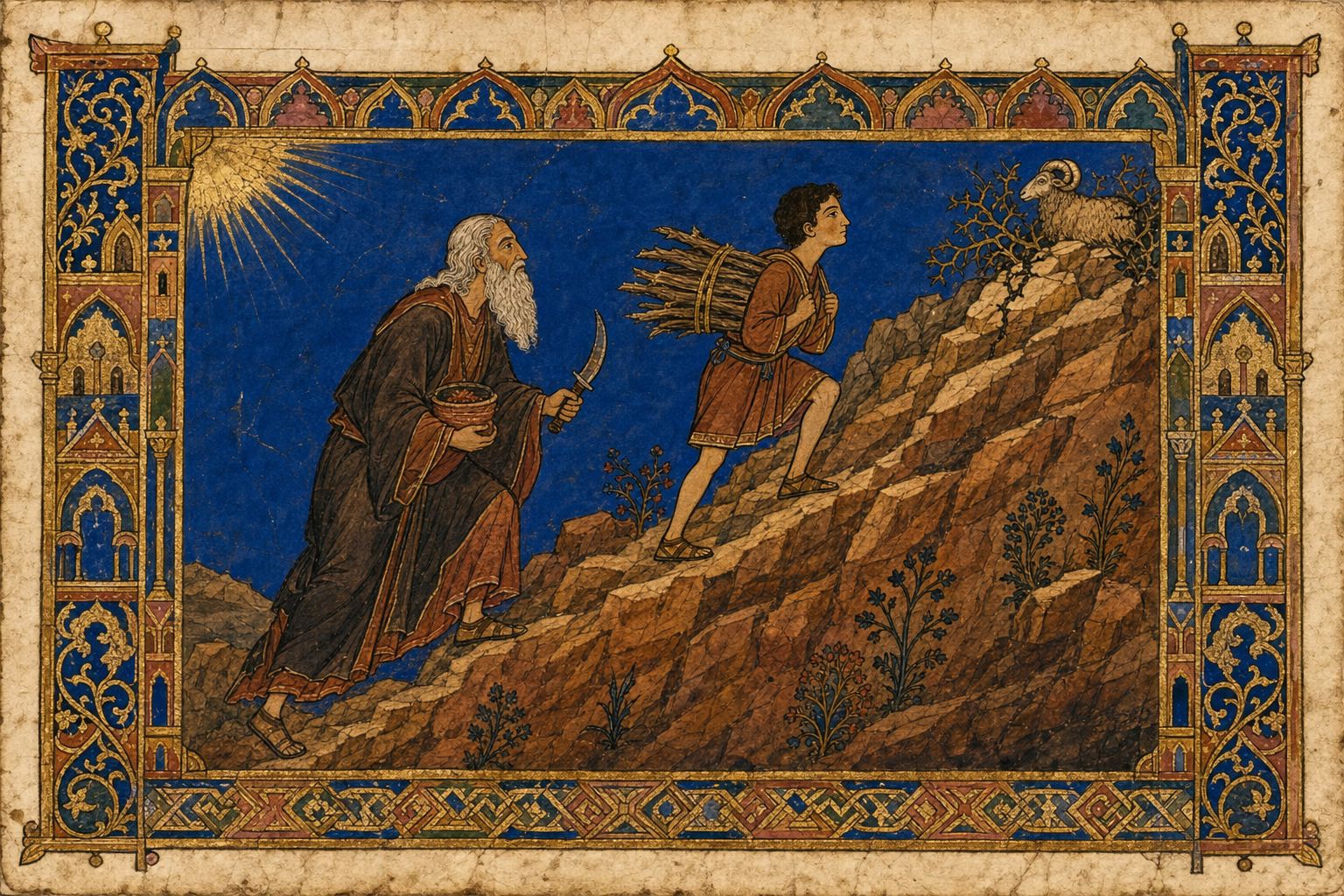
The voice came to Abraham in the deep hour, when the moon had set and the dawn was still a rumor.
Abraham.
He sat up on his mat. He was an old man now, and his bones spoke to him in the cold of the night, but his hearing had not dimmed. He knew that voice. He had heard it on a starlit plain when he was seventy-five and full of fire, telling him to leave his father’s house. He had heard it under the oaks of Mamre when three strangers came walking, and he had run to slaughter a calf for them. He had heard it in the smoke that rose over Sodom. He had heard it the day his wife Sarah, ninety years old and laughing at her own bitterness, was told she would bear a son.
And the son had come. Isaac. Laughter, his name meant. The boy was perhaps twelve now, perhaps thirteen — Abraham had stopped counting in the way young fathers count. Isaac was a serious child, a watcher, a listener. He had Sarah’s eyes.
Here I am, Abraham said.
The voice said: Take now thy son, thine only son Isaac, whom thou lovest, and get thee into the land of Moriah; and offer him there for a burnt offering upon one of the mountains which I will tell thee of.
The dark in the tent did not change. The breeze from the open flap did not still. Somewhere outside, a goat shifted in its sleep, and a watchman coughed once and was silent. Abraham sat with his hands flat on his knees, and he did not move, and he did not speak, and within him a thing was happening that has no name.
He did not say, my Lord, I cannot. He did not say, surely you do not mean what I think you mean. He did not say, but you promised me that through this child all the nations of the earth would be blessed; how can he be the blessing if he is the offering? He did not argue as he had argued for Sodom, pleading the count down from fifty to ten. He did not weep. He did not, in any way that could be seen from outside, refuse.
He said, before the dawn came: Here I am.
He rose. He woke two of his servants. He told them to saddle the donkey. He took wood and split it himself, with his own hands, in the lamplight, while Sarah slept. He laid the wood on the donkey. He took a knife. He took fire in a pot of clay. And then, when all was ready, he went to the inner part of the tent where Isaac slept, and he stood a long time looking at him.
Isaac woke easily. He was that kind of boy. He sat up and saw his father’s face and knew that something had happened, but he did not yet know what.
“We are going on a journey,” Abraham said. “You and I and two of the men. The Lord has called me to a mountain. Come.”
“Where is the lamb?” said Isaac.
“The Lord will provide.”
Isaac dressed without further question. He kissed his sleeping mother on the forehead. He did not know that he was kissing her for the last time — or perhaps he did know, in the way that children sometimes know things they cannot say. He went out into the cold.
They walked for three days.
The first day, perhaps, a man can hold himself in the trance of obedience. He puts one foot down and then the other, and the road is still the road. The second day is harder. The body grows tired and the mind, no longer distracted by the strangeness of departure, begins to gnaw. By the third day, every step is a small new yes, and every small new yes is a small new dying.
On the third day Abraham lifted his eyes and saw the mountain.
He told the servants to wait with the donkey. “The lad and I will go yonder and worship,” he said, “and come again to you.” He did not look at the servants when he said it. He looked at his own hands.
He laid the wood on Isaac’s back. He took the fire and the knife in his own hands. They began to climb.
They climbed for a long time, and the sun was very hot, and the path was steep. Isaac walked ahead. Abraham could see the wood lashed across the boy’s thin shoulders, swaying with each step. His son was carrying the wood that would burn his own body. The thought rose in Abraham like nausea, and he pushed it down, and it rose again.
Halfway up, Isaac spoke for the first time on the climb.
“My father,” he said.
“Here am I, my son.”
“Behold the fire and the wood: but where is the lamb for a burnt offering?”
Abraham’s mouth was dry. He looked at the back of his son’s head — at the dark curls, at the place where the small braid Sarah had tied that morning had come undone. He answered.
“My son, God will provide himself a lamb for a burnt offering.”
And they went both of them together. The father with the fire, the son with the wood, climbing. The path narrowed and then opened, narrowed and then opened. Lizards slipped under stones at their approach. A hawk turned overhead and was gone. The air grew thinner. The boy’s breath came shorter. The old man’s came shorter still.
They reached the place near midday. There was a shelf of flat rock, sun-warmed, surrounded by lower ridges that fell away into haze. Abraham set down the fire pot. He set down the knife. He looked at the rock, and at the wood Isaac had lowered onto the stone, and he began to build the altar.
He gathered the stones with his own hands, fitting them, and Isaac helped him, because Isaac was a good boy and helped his father with everything. They worked in silence. When the altar was the right height, Abraham laid the wood across it in the way he had laid wood for offerings a hundred times before. His hands knew this. His hands knew how to lay wood. His hands had not yet refused.
Then he turned, and he looked at his son.
Isaac saw his father’s face and knew, then, what he had known on the road but had not let himself know. He did not run. He did not cry out. The boy stood very still, the way a deer stands when it has seen the man with the bow, and there is nowhere to go.
“My son,” Abraham said.
“My father,” Isaac said.
Abraham took him by the wrists. Gently. The way a father takes a child’s wrists when he is about to lift him over a stream. He bound them. He bound the boy’s ankles. He lifted him — Isaac was light, lighter than the wood had been on his own back — and he laid him on the altar, on the wood. The wood was rough beneath the boy’s shoulder blades. The sun was very bright. Isaac did not look away.
Abraham took the knife. He stretched out his hand.
Abraham. Abraham.
The voice was urgent now, sharp as light.
Here I am, he said, and his voice broke for the first time in three days.
Lay not thine hand upon the lad, neither do thou any thing unto him: for now I know that thou fearest God, seeing thou hast not withheld thy son, thine only son from me.
The knife fell. The hand fell. Abraham was sixty years older in that instant than he had been a moment before, and also lighter than he had been since the night the voice had first come.
Behind him, in a thicket at the edge of the rock, something moved. He turned. A ram stood there with its great curled horns caught in the briar, struggling without panic, the way an animal struggles when it has been struggling for some time. Abraham went to it. He worked the horns free of the thorns with his old patient hands, the way he had worked his own herds free a thousand times. He led the ram to the altar.
He lifted Isaac off the wood and unbound his wrists and his ankles. The boy stood unsteadily, the cord-marks raw on his skin. Abraham did not embrace him. He did not know if he could embrace him. He set the ram on the altar in the boy’s place, and the knife did its work, and the fire rose, and the wood crackled, and the smell of burnt fat rose into the bright air, and the smoke went up straight, and the smoke was carried away on a wind from the east.
Isaac sat on the rock at the edge of the shelf, his back to the altar, looking out at the haze beyond the lower ridges. Abraham did not call him. He let him be. When the fire had burned down, Abraham gathered the bones and laid them in a small cairn beside the altar, and he stood for a moment looking at the place — the stones he had fitted, the wood now ash, the cord still lying where he had let it fall.
He went and stood beside his son.
“Come, my son,” he said.
Isaac stood. His knees were stiff. He did not look at his father. He started down the path.
Abraham followed.
They came down the mountain by the same path they had climbed. The shadows had grown long. Below them, in the gold light of late afternoon, they could see the two servants waiting beside the donkey, small as grains of wheat. The sound of the donkey braying carried up to them, thin in the dry air.
Isaac walked ahead, his shoulders set. He was no longer the child who had asked about the lamb. The cord had marked his wrists, and the wood had marked his back, and these marks would fade but they would not, finally, fade. He did not turn. He did not speak.
When they reached the servants, Isaac did not look at them. He went to the donkey and pressed his face into its warm side and stood there a long time, breathing the dust and the animal smell. Abraham did not call him. The men did not ask. The sun was beginning to drop into the haze beyond the western ridge, and somewhere on the slope above, the smoke from the altar was still rising thin and straight, going up into the empty sky.