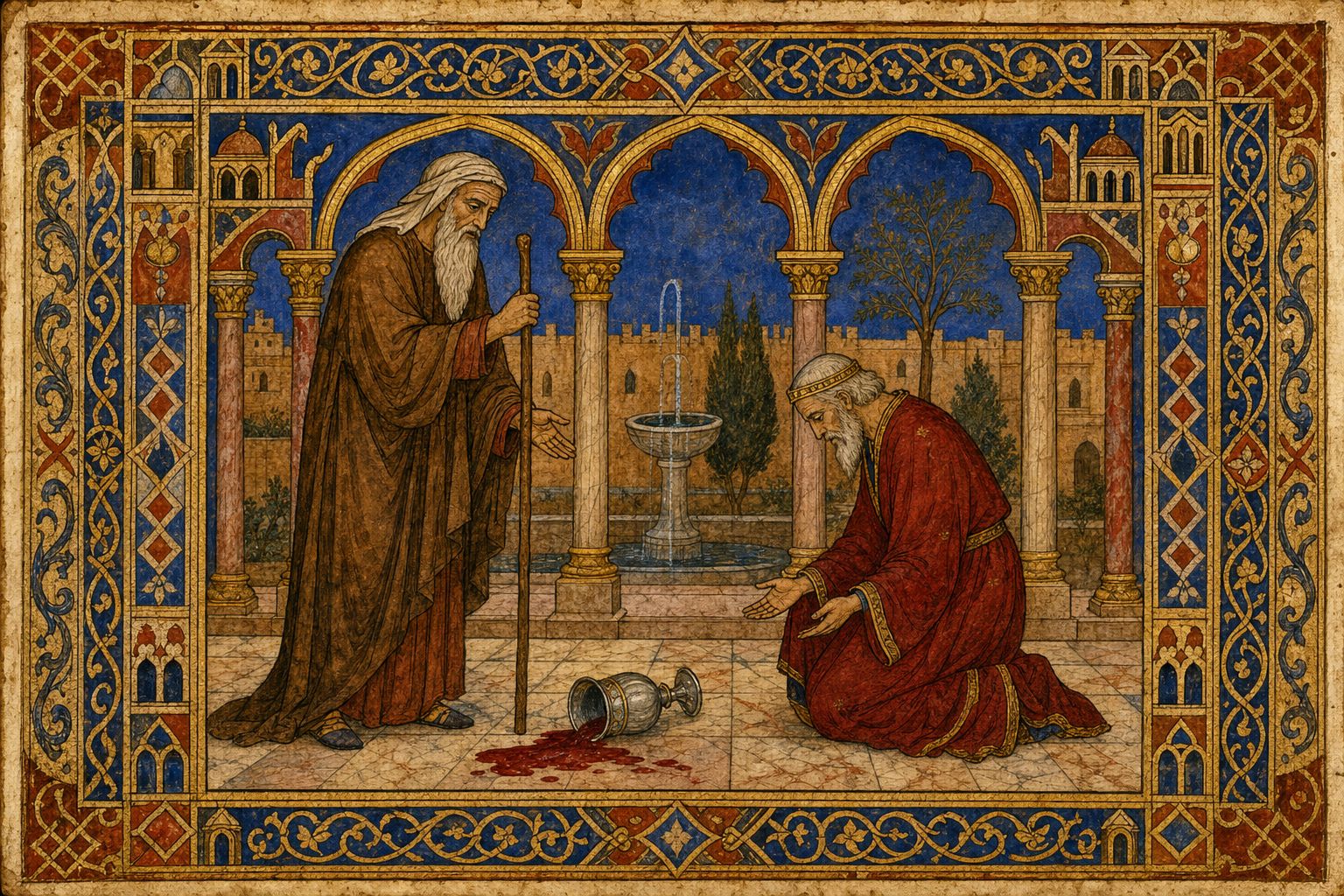
The summer heat lay thick over Jerusalem, and the air in the prophet Nathan’s small house was still as stone. He sat in the corner where the shadows pooled deepest, his hands folded in his lap, his eyes closed. He had been sitting this way since before dawn, listening — not to the sounds of the waking city, but to that other voice, the one that came without warning and changed everything it touched.
When at last he opened his eyes, his face was grave. He knew where he had to go, and he knew what he had to say. What he did not know was whether he would walk out of the king’s palace alive.
He rose slowly. He was not a young man anymore. He took his staff, wrapped his cloak about his shoulders despite the heat, and stepped out into the bright morning.
The streets were full. Merchants shouted over piles of figs and pomegranates. Children chased one another between the stalls. A woman beat dust from a rug at her doorway, and the dust rose golden in the sunlight. Nathan walked through it all as a man walks through a dream — present but not quite touching it. He was thinking of David.
He had known David since the boy first came down from the hills with the smell of sheep on him and a harp slung over his shoulder. He had watched him slay giants and flee from kings and dance before the Ark of the Covenant with such joy that Michal his wife had despised him for it. He had watched him build a kingdom out of nothing but courage and song. He loved David. That was the trouble. He loved him, and he had to break him.
For David had done a terrible thing.
There had been a woman bathing on a rooftop. Her name was Bathsheba, and she was the wife of Uriah the Hittite, one of David’s most loyal soldiers — a man then away at war, fighting for his king. David had seen her from his palace roof, and he had wanted her, and being king, he had taken her. And when she sent word that she was with child, David had summoned Uriah home from the battlefield, hoping the soldier would lie with his wife and so cover the matter. But Uriah was a better man than his king. He would not go down to his house while his comrades slept on the open ground. He slept instead at the palace gate.
So David had written a letter, and given it to Uriah himself to carry back to the front. And the letter said: Set Uriah in the forefront of the hottest battle, and retire from him, that he may be smitten and die.
And Uriah had carried his own death warrant in his hand, and delivered it, and died as he was told to die.
Then David had taken Bathsheba into his house, and she had borne him a son, and the king had told himself the matter was closed.
But the matter was not closed. The Lord had seen.
And now Nathan walked toward the palace gates, and the guards lowered their spears at his approach and then lifted them again, for everyone knew the prophet, and no one stopped him.
He found the king in the cool inner court, beside the fountain. David was older now, his beard threaded with grey, but still handsome, still the boy who had sung to the sheep. He looked up and smiled when he saw Nathan, and rose to embrace him.
“Old friend,” said David. “You come too rarely.”
“I come when I am sent,” said Nathan.
David heard something in his voice. The smile faded a little, but he gestured for Nathan to sit, and called for wine and bread. They sat together by the water. For a long moment Nathan said nothing, and David waited, the way a man waits for a physician to speak.
At last Nathan said, “My lord king, I have come to tell you of a matter that has happened in your kingdom, and to ask your judgment.”
“Tell me,” said David. He leaned forward. He had always loved a case to judge. He had a gift for it.
And Nathan began.
“There were two men in a certain city. One was rich, and the other was poor. The rich man had very many flocks and herds — sheep on a hundred hills, cattle in every valley. He had servants to tend them and more wool and milk and meat than he could ever use. He lived in plenty, and his table was never empty.
“But the poor man had nothing. Nothing — except one little ewe lamb, which he had bought when it was small, and which he had brought up in his own house, with his own children. It ate of his own bread. It drank from his own cup. It lay in his arms at night, and it was to him as a daughter. He had no other thing in all the world to love. The lamb was his joy.”
David was listening now with his whole self. Nathan saw his hand tighten on the cup.
“And there came a traveler unto the rich man,” Nathan went on, his voice low and steady, “and the rich man was loath to take of his own flock and of his own herd, to dress for the wayfaring man that was come to him. So he took the poor man’s lamb. He sent his servants, and they went into the poor man’s house, and they took the one little lamb out of the poor man’s arms, and they slaughtered it, and dressed it, and served it up to the traveler at the rich man’s table. And the rich man ate, and was satisfied, and thought no more of it.”
The court was very quiet. Somewhere a dove called. The water in the fountain trickled.
David’s face had darkened. He stood up. The cup tipped from his hand and clattered on the stones, and the wine spilled red across the marble.
“As the Lord liveth,” he said, and his voice shook with anger, “the man that hath done this thing shall surely die! And he shall restore the lamb fourfold, because he did this thing, and because he had no pity!”
Nathan looked up at him. He was an old man, sitting in the shadow of a king, and the king stood over him in fury. Nathan did not rise. He did not look away. He spoke very quietly, and every word was a stone laid in place.
“Thou art the man.”
The silence that followed was the silence of the world ending.
David did not move. He stood as if struck, his mouth open, his hand still raised from his oath. The color drained from his face. The whole shape of him seemed to alter, as if something inside him had collapsed all at once.
Nathan went on, because he had to. Because the voice that had sent him had not finished speaking.
“Thus saith the Lord God of Israel: I anointed thee king over Israel, and I delivered thee out of the hand of Saul. I gave thee thy master’s house, and thy master’s wives into thy bosom, and gave thee the house of Israel and of Judah; and if that had been too little, I would moreover have given unto thee such and such things. Wherefore hast thou despised the commandment of the Lord, to do evil in his sight? Thou hast killed Uriah the Hittite with the sword, and hast taken his wife to be thy wife, and hast slain him with the sword of the children of Ammon.”
David did not speak. He sank to his knees beside the fountain. His hands were open in his lap, palms up, like a man who has dropped something and cannot find it.
Nathan rose, leaning on his staff. He looked down at the king — at his friend, at the boy who had once played the harp until the demons left Saul’s eyes, at the man who had built a city and broken a heart and ordered a faithful soldier to his death. And Nathan was filled with a sorrow so heavy he could hardly bear it.
“Now therefore,” he said, “the sword shall never depart from thine house, because thou hast despised the Lord, and hast taken the wife of Uriah the Hittite to be thy wife.”
David lifted his face. His eyes were wet. He did not try to hide it. He did not call his guards. He did not protest. He did not say, I am the king, and who are you to speak so to me? He said only, in a voice that was barely his own:
“I have sinned against the Lord.”
And Nathan looked at him for a long moment. The anger in him softened, though the sorrow did not. For he saw that David, even now — even broken, even guilty, even with the blood of an innocent man on his hands — was still the man whose heart could be turned. Who could hear, and know, and confess. That was the rarest thing in any king. That was perhaps the rarest thing in any man.
“The Lord also hath put away thy sin,” Nathan said gently. “Thou shalt not die.”
He turned then, and walked slowly out of the court, past the fountain and the spilled wine, past the bowed head of the king, and out into the bright streets of Jerusalem, where the children were still chasing one another and the woman was still beating her rug and the world had not noticed that anything at all had happened.
But David remained on his knees by the water for a long time. And in the days that followed, he wrote a song. It began like this:
Have mercy upon me, O God, according to thy lovingkindness: according unto the multitude of thy tender mercies blot out my transgressions. Wash me throughly from mine iniquity, and cleanse me from my sin. For I acknowledge my transgressions: and my sin is ever before me.
And men have been singing it ever since.