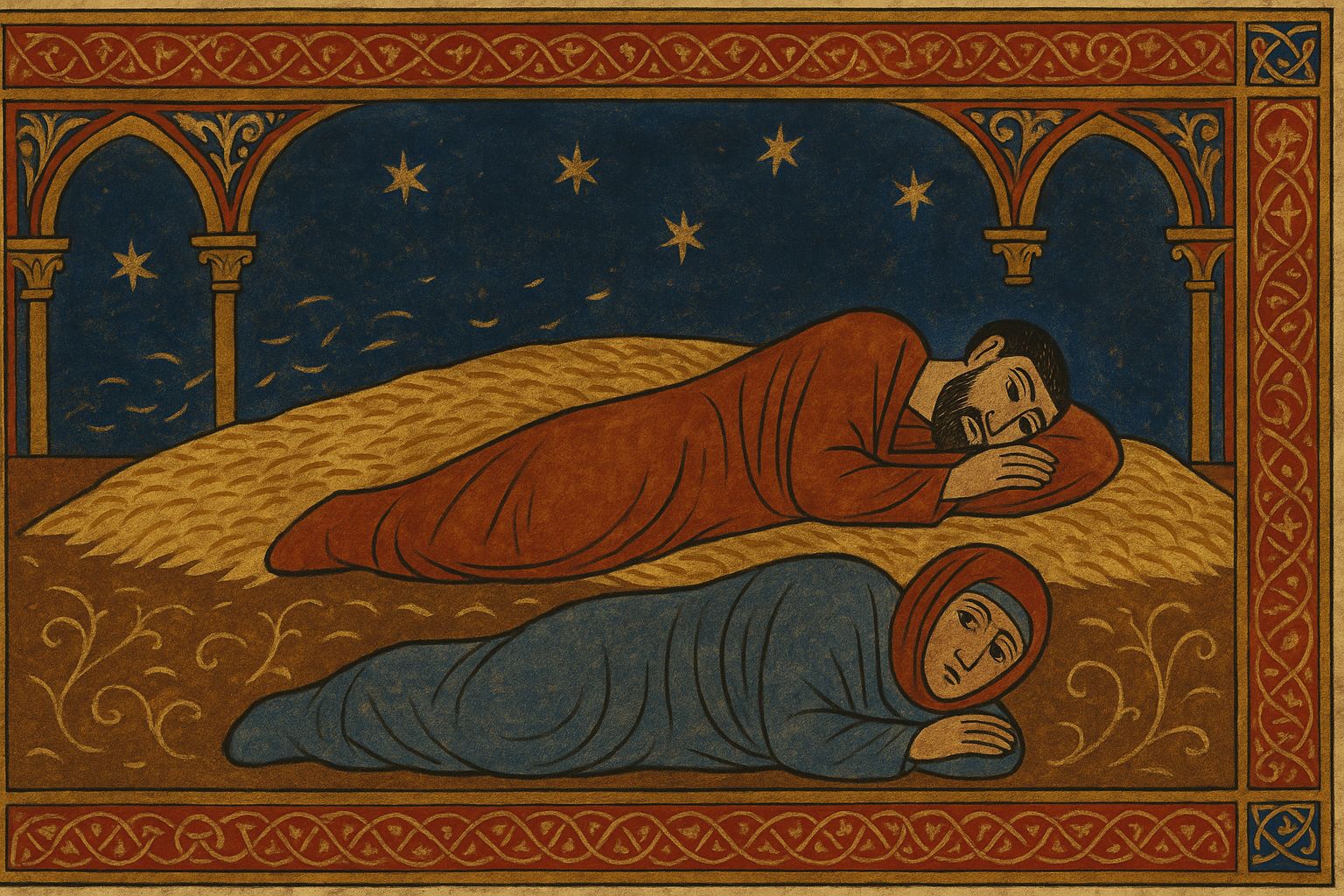
The barley harvest had ended, and the wheat after it, and through all those weeks Ruth had gone out at first light and come back at dusk with the ache of stooping in her spine and the chaff worked into the creases of her hands. She had grown used to the smell of cut straw, to the way the heat lay over the fields like a hand pressed flat. She had grown used, too, to the silence in the small house in Beth-lehem — the long evenings when Naomi sat with her thoughts and the lamp guttered low between them.
It was Naomi who broke that silence, on the evening she had been waiting to break it.
My daughter, shall I not seek rest for thee, that it may be well with thee?
Ruth set down the bowl she was holding. Across the room the older woman’s face was turned toward her, and there was something in it that had not been there for a long while — not the bitterness she had carried back from Moab, not the grief that had hollowed her at the gate when the women cried out her old name. Something else. A purpose, gathering.
Boaz was winnowing barley that night on the threshing-floor, Naomi said. He was their kinsman; Ruth had kept by his maidens through the whole of the harvest, and he knew her, and he was a man of his word. So Ruth was to wash, and anoint herself, and put her good raiment on, and go down to the floor in the dark. She was not to make herself known while he ate and drank. She was to watch where he lay down when his work was done, and when he slept she was to go to him quietly, and uncover his feet, and lie down there. And he will tell thee what thou shalt do.
Ruth listened without moving. She understood what was being asked. A foreign woman, a Moabitess, going alone in the night to the place where the men slept beside their grain — she understood the size of it, and the danger in it, and the way a single wrong word could turn it into shame she would never wash off. She thought of the field, of the day he had called her my daughter and told the young men not to touch her, of the parched corn he had reached to her with his own hand until she was satisfied and there was bread left over. She thought of the road out of Moab, and the words she had said on it, that nothing but death would part her from this woman.
All that thou sayest unto me I will do, she said.
She washed at the back of the house where the water jar stood. She rubbed the sweet oil into her arms and her throat, and the cheap clean smell of it sat strangely on her after so many weeks of dust. She put on the raiment she had brought from Moab and not worn since, and in the dark she could not see it but she could feel the difference of it against her skin. Then she went out, past the last houses, down the slope toward the floor, with the night air cooling on her face and the stars hard and small overhead.
The threshing-floor was a beaten circle of earth at the lip of the rise, where the wind came clean across it. The men were there. She heard them before she saw them — voices loosened by wine and by the end of a long labor, a low laugh, the scrape of a bowl. She kept back in the dark beyond the heaped grain and waited, the way Naomi had told her to wait, while the smell of roasted meat and new bread and the chaff still hanging in the air settled around her. One by one the voices thinned. Men lay down where they had eaten, along the heap, to guard it through the night.
She watched for him. She saw him rise at last, heavy and content, his heart merry with the bread and the wine, and go to the far end of the long heap of corn and lower himself down against it, drawing his cloak over himself. She waited longer than she thought she could bear to wait. The cold of the ground came up through her. An owl went over once, low, and was gone. When his breathing had gone slow and even and the floor was nothing but sleeping men and the wind, she crossed the open ground without a sound, the way she had learned to move in the field so as not to be seen, and she came to where his feet were, and she lifted the edge of the cloak from them, and she lay down there in the dark, and was still.
She did not sleep. She lay with her cheek near the earth and counted nothing, and the grain smelled of summer beside her, and the man slept on, and she did not know what hour it was except that it was the deep middle of the night when the body is at its lowest and a sound carries far.
He moved. A sharp turn, a man startled out of sleep by something his sleeping mind had felt — the cold where the cloak had been, the weight of another person near him. She felt him go rigid. His hand went out. She heard him draw a breath to speak and hold it, and then in a voice pitched low so that it would not wake the others, but tight with the alarm of it, he said into the dark:
Who art thou?
She had had hours to say it and still it came out of her unsteadily.
I am Ruth thine handmaid, she said. Spread therefore thy skirt over thy handmaid; for thou art a near kinsman.
The words went out from her and there was nothing she could do to call them back. She lay in the long silence after them and listened for what would come, and in that silence she could hear her own heart, and the wind moving the loose chaff across the floor, and somewhere along the heap a man turning in his sleep, unknowing.
When Boaz answered, his voice had changed. The alarm had gone out of it. What was in it now was something close to wonder, and it was gentle, and it was still low so that it would stay between the two of them.
Blessed be thou of the LORD, my daughter, he said. Thou hast shown more kindness in the end than at the beginning, inasmuch as thou didst not follow the young men, whether poor or rich. She was not to be afraid. He would do for her all that she had said. All the men in the gate of his people knew that she was a virtuous woman; he was not a man who did not know it.
And then he told her the thing that hung over it. It was true that he was a near kinsman — but there was a kinsman nearer than he, one with the first right, and the matter could not be settled in the dark by the two of them alone. Tarry this night, he said. In the morning he would go to that man. If the man would do the kinsman’s part, then well; let him do it. But if he would not — then will I do the part of a kinsman to thee, as the LORD liveth. She was to lie down until morning.
So she lay at his feet until the morning, and neither of them slept much, and neither of them spoke again, and the cold deepened the way it does in the last black hour and then began, very slowly, to lift. He woke her — or she had not been asleep — while it was still too dark for one man to know another’s face across the floor, because it must not be known that a woman had come there. He told her to bring the mantle she wore and hold it open, and she held it, and he measured grain into it, six measures of barley, the weight of it pulling the cloth down hard against her arms. He laid it on her. Then he went up toward the city, and she went down toward the house, the barley heavy against her body and the eastern sky going gray behind her.
Naomi was awake. She had not slept either. She rose when the door moved and she could not yet see who it was, and she said into the half-dark, Who art thou, my daughter? — and Ruth came in and set the grain down and told her all of it, all that the man had done, and how he had said she was not to go empty-handed back to her mother-in-law, and had given her the six measures for that reason.
Naomi heard her out. Then she told her to sit still, and wait, and not to go anywhere or do anything, until she knew how the matter would fall. The man would not rest, she said. He would not let the day pass without finishing the thing.
Ruth sat. Outside, the light was coming up over Beth-lehem, and the grain stood in its heap on the floor below the city, and somewhere along the road a man was already walking toward the gate.