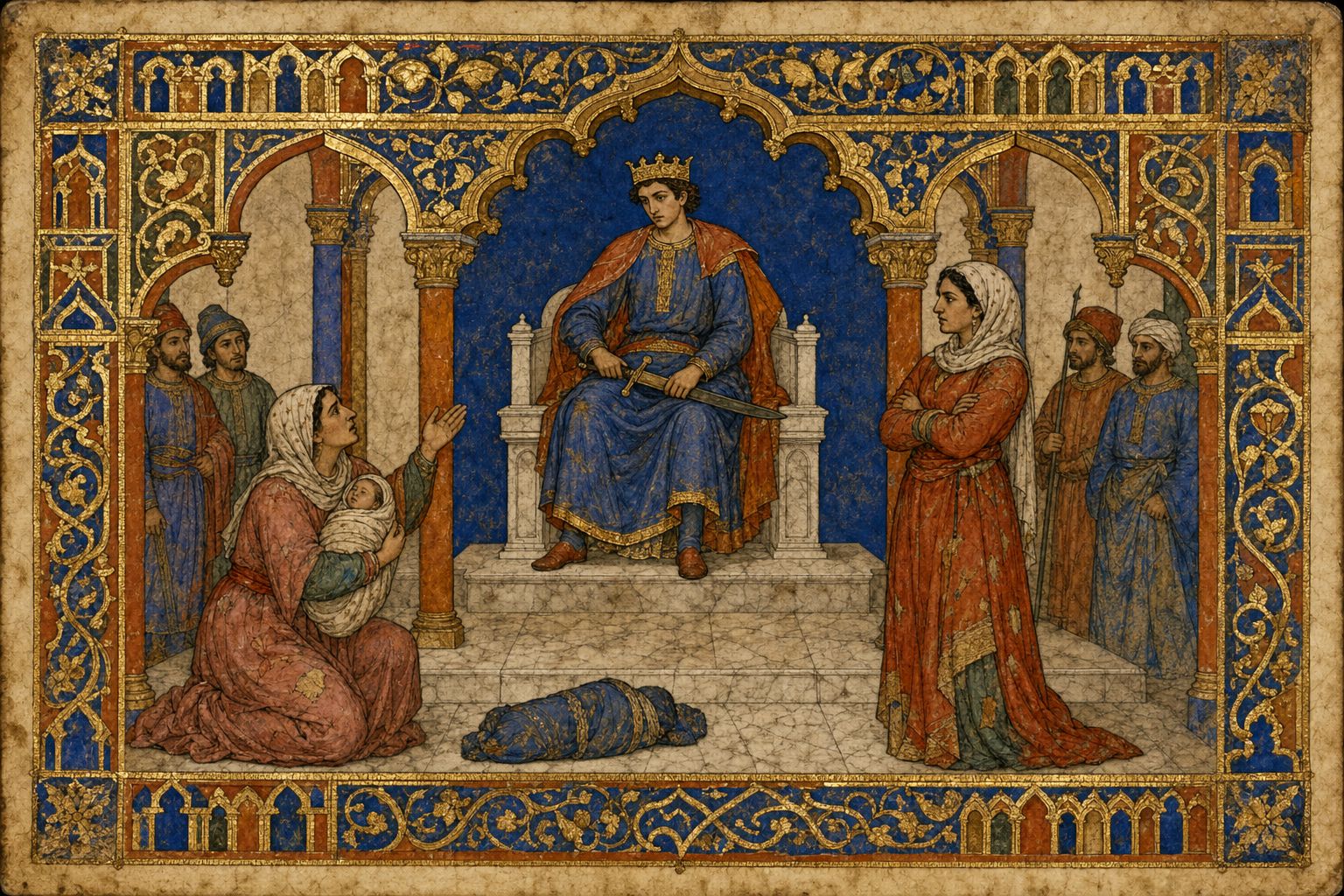
Solomon was young that year — perhaps twenty, perhaps not yet twenty. He was the son of David and Bathsheba, born after the first child had died, born into a court still trembling from the wars of his father’s old age. The crown sat on his head as if it had not yet decided whether to stay.
A few weeks before, in the night, he had dreamed. He had stood at the high place at Gibeon, and a voice had said, Ask what I shall give thee. He had not asked for long life. He had not asked for the death of his enemies. He had not asked for riches. He had asked for an understanding heart, to judge between good and bad. The voice had been pleased, and had given him this, and had given him the other things besides, because he had not asked for them.
He had woken before dawn with his hands shaking.
A king cannot live on dreams. The work of judging came soon, and it came on a hot afternoon, and it came in the form of two women.
They appeared in the audience hall without warning. The court was crowded — petitioners with grain disputes, an ambassador from Tyre still waiting to be received, a scribe at the king’s right hand bent over his clay — and the women did not wait their turn. They pushed past the steward, weeping, dragging between them a small bundle wrapped in linen. The guards moved to stop them. Solomon raised his hand and the guards stepped back.
The women were not respectable. Anyone could see that. They wore the bright cloth and the heavy paint of their trade. They lived together in a single house at the edge of the city and sold the only thing the city had taught them they could sell. They had no husbands. They had no fathers in this city to come and speak for them. They had only themselves, and they had only each other, and now they had this dispute, which was beyond the elders of their quarter, which was beyond the magistrates of the lower court, which had risen all the way to the king.
One of them spoke. She was perhaps a little older than the other, her eyes red, her voice thin from weeping.
“My lord,” she said, “I and this woman dwell in one house. And I was delivered of a child with her in the house. And it came to pass the third day after that I was delivered, that this woman was delivered also. And we were together; there was no stranger with us in the house, save we two.”
She drew a long breath. The bundle in her arms was not moving.
“And this woman’s child died in the night, because she overlaid it.”
The other woman cried out. “It is not true!”
“It is true,” said the first woman. “She laid on her own child, and it smothered. And she rose at midnight, and took my son from beside me, while thine handmaid slept, and laid it in her bosom, and laid her dead child in my bosom. And when I rose in the morning to give my child suck, behold, it was dead: but when I had considered it in the morning, behold, it was not my son, which I did bear.”
“Liar!” shouted the second woman. “The living is my son, and the dead is thy son!”
“Nay,” cried the first, “but the dead is thy son, and the living is my son!”
And so they spoke before the throne, the same words back and forth, the dead is thine, the living is mine, and there was no witness, and there was no proof, and one of them was lying. The court fell silent. The scribe stopped writing. The ambassador from Tyre forgot his own business and stared. The young king sat very still on his father’s throne, and his hands were folded on his lap, and only the smallest tremor showed at the corner of his mouth.
He looked at the bundle. One of the women was opening it now — gently, as a mother opens a sleeping child’s wrap to show its face. The infant inside was alive. It opened its mouth in a small mewing cry. It was a few weeks old. It had a small dark crown of hair.
He looked at the other bundle, which lay on the marble floor at the women’s feet. No one wanted to touch it. The dead child was a stranger now to both women.
A long moment passed. Solomon did not move. The guards along the wall did not move. Then the king said, in a voice that was perfectly calm:
“Bring me a sword.”
A guard moved. There was a small commotion at the side of the hall. A sword was brought — a real sword, the heavy bronze short-blade of the king’s house guard — and laid in Solomon’s hand.
The king rose. He stepped down from the throne. He took the sword and walked to the place where the women stood. The hall did not breathe.
“Divide the living child in two,” he said, “and give half to the one and half to the other.”
One of the women — the one who had spoken first — opened her mouth. Whatever sound she had been about to make died in her throat. She clutched the child against her own chest, and her face did a thing that has no good name in any language. She fell to her knees on the marble, and she did not weep prettily. She made the loud, broken, animal sound that comes out of a woman when she is told that her child is going to die.
“Oh my lord,” she cried, “give her the living child, and in no wise slay it.”
She looked up at him. Her face was wet. Her hands were lifted toward him, palms open.
“Give it to her. Give it to her. Only do not kill it.”
The other woman, the second woman, was watching her. Her face was strange. After a long moment she said — and her voice was hard, almost bored — “Let it be neither mine nor thine, but divide it.”
A breath went through the hall.
Solomon turned to the guard and handed the sword back. He looked at the second woman for a long moment, and then at the first.
“Give her the living child,” he said, “and in no wise slay it: she is the mother thereof.”
He pointed at the kneeling woman, and the guards lifted her up gently, and the child was brought to her, and she took it, and she pressed her face into the small dark hair on its head, and she did not say anything because she did not need to say anything. She walked out of the hall without bowing, holding her son. The other woman walked out the other way, between the columns, into the bright light of the courtyard, and was not seen in that court again.
The whole thing had taken perhaps eight minutes.
Solomon went back to the throne and sat down. He did not speak. The scribe at his right hand wiped his hand on his robe — it was sweating, though the hall was cool — and bent again over his clay tablet, and pressed the wedges in carefully, his stylus making the small dry sound of a stylus on damp clay. The ambassador from Tyre forgot, for a long moment, why he had come.
Outside, in the streets of Jerusalem, the woman walked home with her child. The afternoon was hot and the sun was on the white stones of the city walls, and the child was still mewing softly against her shoulder, and she did not yet trust her hands to stop trembling. She came at last to the door of her house and went in, and she sat down on the floor beside the cold ashes of the morning’s fire, and she held her son in her lap, and she did not get up for a long time.
In the audience hall, Solomon called the next petitioner. The grain dispute was heard. The ambassador from Tyre was received. The afternoon went on as afternoons do.
But the scribe, when he went home that night, did not eat. He sat on his roof and looked at the stars, and he turned the little tablet over and over in his hands, the wedges still soft, and he thought about the woman’s open palms and the king’s calm hand on the sword, and he did not know exactly what he had seen.
He only knew that he had seen it.