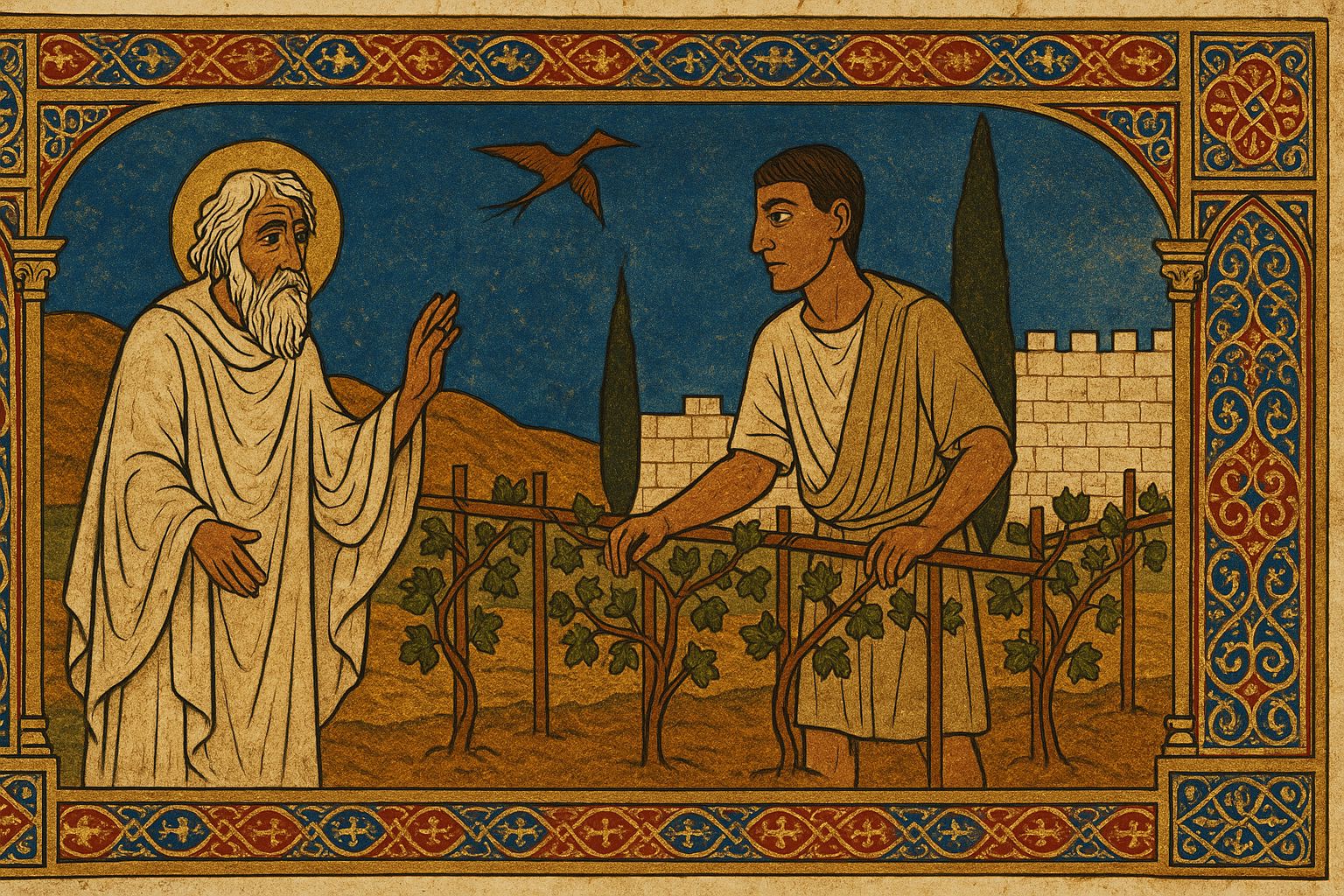
The vines were in their fourth year, and Naboth had been up since first light, pruning. The earth between the rows was dark with dew, and where he set his sandal it kept the print. The sun climbed over the ridge of Gilboa and the leaves caught the wet light and flared.
He had inherited the land from his father, and his father from his — four generations of it now, the old terrace walls lichened and pale, the cisterns sunk deep into the limestone behind the press. He knew where the soil thinned and where it held. He knew the shape of every stone.
Beyond the lower wall stood the king’s lodge. Ahab kept rooms there for the seasons when Samaria grew too hot, and his garden ran almost to the boundary — figs, pomegranates, a cypress brought down from Tyre. Naboth had watched the cypress put on a hand of growth each year for a decade. It cast no shade he wanted.
The runner came up the path while Naboth was bent over the lowest row. He heard the sandals slap the stones before he saw the man. The runner was young, his tunic soaked dark at the chest, breathing through his teeth.
“The king will speak with you,” the runner said. “In the garden.”
Naboth straightened. He could see Ahab already, pacing among the fig trees, hands clasped behind his back. The king wore no diadem this morning, only a linen wrap against the heat, and at this distance and in that posture he looked like any heavy-set landowner pricing out a season.
Naboth wiped his palms against his thigh and went.
Ahab did not waste words. “Give me your vineyard. I will give you a better — anywhere in my kingdom you name. Or, if it pleases you, the worth of it in silver. I want it for a garden of herbs. It is hard against my house.”
The vineyard lay between them as he spoke. Four rows down the slope, the earth around the roots still damp from the drawing of water at dusk. The vines were stretching their first runners along the trellis cords. The grapes when they came would be small and dark and slow.
“The Lord forbid it me,” Naboth said, “that I should give the inheritance of my fathers unto thee.”
He spoke softly. He had practiced no speech. The words came out as he had once heard his father say them at a market in Samaria, refusing some other man some other thing. The inheritance of my fathers. He felt the ground under his feet as he said it.
Ahab’s face went still. He looked at Naboth a long moment, and Naboth saw that the king had not expected to be answered. Then Ahab turned without a word and walked back through the figs. The runner went after him at a stumble. The cypress stood where it had always stood.
Naboth went back to his pruning. By midmorning he had finished the lowest row.
That afternoon in the lodge at Jezreel the king lay on his bed and turned his face to the wall. The servants brought meat and he sent it away. They brought bread and wine and he sent these away also. He drew his knees up under the linen and would not speak.
Jezebel came in toward evening. She stood in the doorway and watched him a moment, her rings catching the lamplight. She was a tall woman with a long plain face and very steady eyes.
“What ails thee,” she said, “that thy spirit is so sad, that thou eatest no bread?”
He told her. He told it the way a child tells. He had asked, the man had refused, the man had spoken of his fathers.
She did not sit down. She looked at him on the bed for what seemed a long time, and then she said, “Dost thou now govern the kingdom of Israel? Arise, eat bread, and let thine heart be merry: I will give thee the vineyard of Naboth the Jezreelite.”
She went out.
In her own chamber she called for parchment and the king’s seal. The scribe was a slight man with stained fingers, and he wrote what she dictated without lifting his eyes. She named the elders of Jezreel and the nobles by their houses. She wrote that a fast should be proclaimed and Naboth set on high among the people. She wrote that two men, sons of Belial, should be set before him to bear witness that he had blasphemed God and the king. She wrote that he should then be carried out and stoned, that he might die.
When the wax cooled she pressed the king’s seal into it and watched the lion sink.
The letters went out by runners through the dusk.
The fast was held three days later. Naboth was called to the gate and seated where the elders sat at the new moon. He did not know why. He had brought oil with him in case the meeting touched on offerings. The square was full. Children sat on their fathers’ shoulders. Women stood in the doorways of the houses that ringed the square.
The two men came forward. Naboth did not know them. They were dressed plainly, like travellers, and they had the look of men who had eaten well that morning. They stood before the elders and one of them lifted his arm and pointed at Naboth and said, in a clear voice that carried over the heads of the crowd, that this man had cursed God and the king.
Naboth heard the words and could not at once make them connect to himself. He turned to the elder beside him as if to ask for the meaning of an unfamiliar phrase.
The elder would not look at him.
The second witness spoke, almost the same words. The crowd took a step nearer and then a step back. A woman in a doorway covered her mouth.
They led him out of the gate. He went without speaking. He had begun to understand and had nothing yet to say. The path beyond the wall ran down past the threshing floor to a place where the ground was bare and the stones lay ready, as if they had been waiting some while.
The first stone struck him in the shoulder. He did not see who threw it. The second took him on the side of the head and he went down to his knees in the dust and covered his face with his arms. After that the stones came quickly and from many hands and he did not rise again.
When it was done the dogs came down from the upper village to the place where his blood had run between the stones, and they licked it.
A runner went up to Samaria with the news. The runner spoke first to Jezebel. She heard him out and gave him a coin and went into the king’s chamber.
“Arise,” she said. “Take possession of the vineyard of Naboth the Jezreelite, which he refused to give thee for money: for Naboth is not alive, but dead.”
Ahab did not ask how. He rose from the bed and called for his sandals and his cloak and went down to Jezreel that very afternoon.
He came into the vineyard alone, at the hot hour, with his servants waiting at the wall. The vines were as Naboth had left them. The pruned canes lay in small piles at the ends of the rows. The earth held the print of one sandal beside the lowest cistern.
Ahab walked among the vines. He set his hand on the trellis cord. He bent and turned a leaf to see the underside. He was thinking already of the herbs he would put here — coriander along the lower wall, hyssop where the soil thinned, perhaps a single pomegranate at the corner where the cypress threw its evening shadow.
He looked up and Elijah was standing at the head of the row.
The prophet had come down out of the hills and his cloak was white with the dust of the road. He was a thin man, all sinew, his beard wild and his eyes deep set. He carried no staff. He stood at the head of the row and did not move.
Ahab said, “Hast thou found me, O mine enemy?”
“I have found thee,” Elijah said. “Because thou hast sold thyself to work evil in the sight of the Lord.”
He spoke quietly. The words travelled down the row of vines as if along the trellis cord itself.
“In the place where dogs licked the blood of Naboth shall dogs lick thy blood, even thine.”
Ahab did not answer at once. He stood among the vines with his hand still on the cord. A bee moved past his ear. Somewhere above them a kite turned on the air.
“And of Jezebel also,” Elijah said. “The dogs shall eat Jezebel by the wall of Jezreel.”
Then he turned and went back up the path toward the hills, and the dust rose where he walked and hung a long while in the level light.
Ahab stood among the vines. After a time he tore the linen at his throat. The sound of the cloth parting was very small in the open air. He sank down between the rows and put his forehead against the warm earth, and his shoulders shook once and then were still.
The servants at the wall did not call to him. They watched him lie there and they kept their silence. Above the vineyard the kite turned and turned and at last slid away westward over the ridge of Gilboa.
In the village the dogs had gone back up to their doorways. They lay panting in the strips of shade. One of them, an old one, rose and stretched and walked down again toward the gate, where the stones still lay in a heap by the threshing floor and the flies had begun to settle.