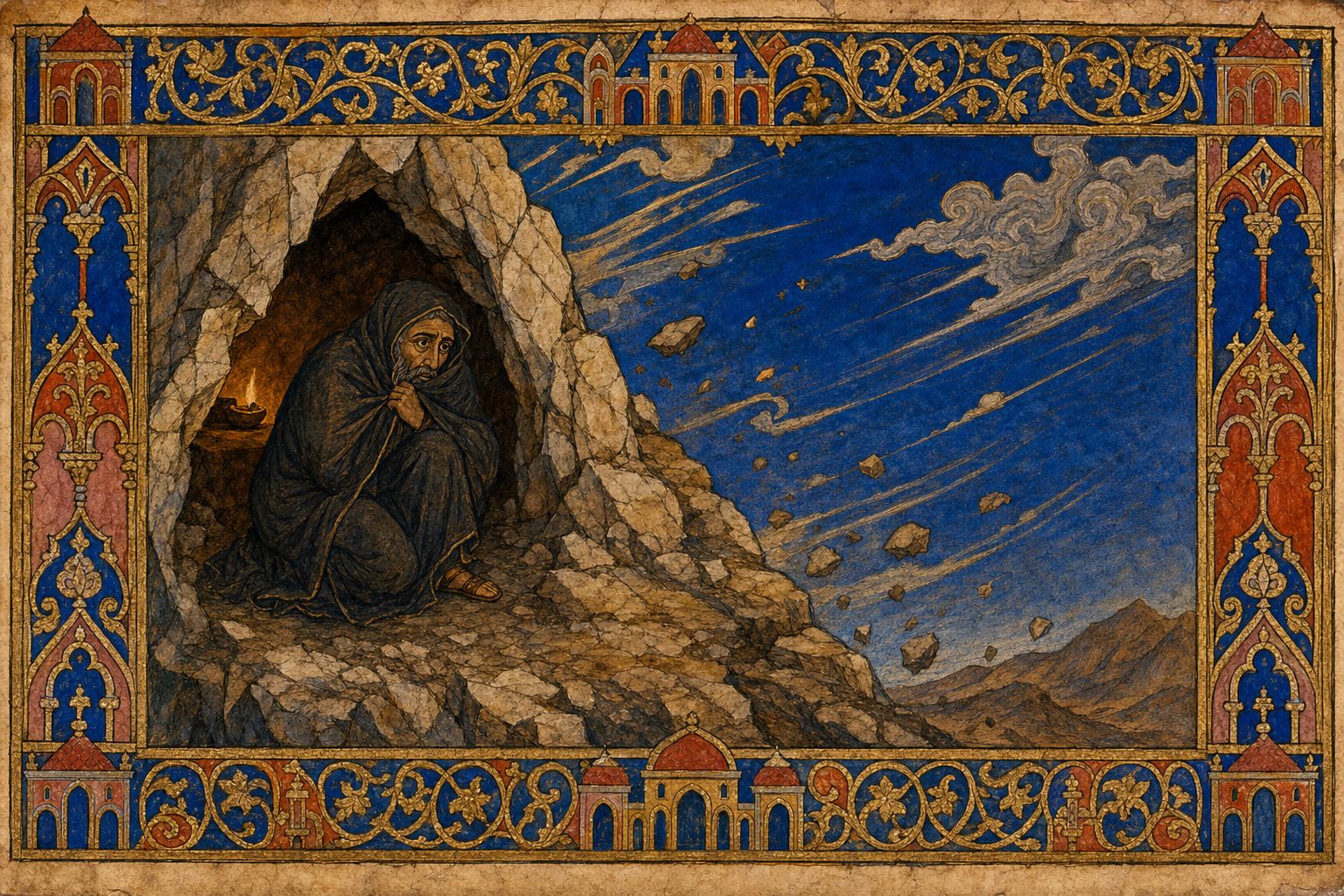
The threat reached him by messenger, written in Jezebel’s own hand, and it was brief the way a blade is brief. She had read the reports from Carmel — the four hundred and fifty prophets of Baal lying dead in the Kishon, the rains returning at Elijah’s word, the sky purple and churning after three years of drought — and she had not wept or prayed or reconsidered. She had sent a single sentence: So let the gods do to me, and more also, if I make not thy life as the life of one of them by to morrow about this time.
He ran.
It was not cowardice, exactly. It was something beneath cowardice, something closer to the body’s animal knowledge that it has spent everything and has nothing left to spend. The fire had gone out of him as suddenly as it had come. A day before, on the heights above the Kishon, he had stood with his arms raised and called heaven down onto wet wood and wet stone, and the wood and the stone had burned. Now he was running south through the night with one servant and no plan, the road dust rising white around his sandals, Jezreel receding behind him into the dark.
He came to Beersheba and left his servant there. He did not explain. He walked alone into the wilderness.
The broom tree stood in a shallow wadi, pale and thin-leafed against the sand. Its shade was modest — barely enough to cover a sleeping man — but he did not need much. He lay down under it and felt the ground through the thin mat of his cloak and let his eyes close. The sun was already hot and rising. He did not care.
It is enough, he said. He was not sure who he was speaking to, or whether the words were prayer or just the sound exhaustion makes when it runs out of silence to fill. It is enough; now, O Lord, take away my life; for I am not better than my fathers.
He slept.
What woke him was not a sound but a touch — something light on his shoulder, the pressure of a hand. He opened his eyes and there was no one, but beside him on the ground lay a cake baked on coals and a cruse of water. The coals still glowed faintly. The water was cool. He could smell the bread the way you smell bread when you are very hungry, deeply, from somewhere behind the throat.
He ate, and drank, and lay down again.
A second time the touch came, and the voice with it: Arise and eat; because the journey is too great for thee.
He rose. He ate the bread. He drank the water. He looked at the coals, already cooling into gray, and at the empty wadi stretching south toward nothing visible, and he thought about turning back. He thought about his servant waiting in Beersheba. He thought about Jezebel’s letter and the weight of the word tomorrow.
Then he rose and walked.
Forty days and forty nights, south and then east, through the Negev, into the Sinai. The country grew more ancient as he moved through it, more stripped of everything soft. By day the rock faces were the color of old blood. By night the cold came fast and the stars were thick and low, the way they are only in desert air. He did not count the days. He moved when he could move and rested when he could not. The bread and the water from that first morning seemed to sustain him in some way he could not account for, the way certain words stay with a person longer than they should.
He came at last to Horeb.
He found a cave in the rock face and went in and spent the night there, lying on his side on cold stone, listening to the wind move across the mountain’s face. And in the dark — or perhaps it was already morning, the dark was the same — he heard the voice he had been listening for and dreading.
What doest thou here, Elijah?
The question was plain and without accusation, but it opened something in him he had not known was sealed. He answered quickly, the way a man answers when the words have been dammed too long. I have been very jealous for the Lord God of hosts: for the children of Israel have forsaken thy covenant, thrown down thine altars, and slain thy prophets with the sword; and I, even I only, am left; and they seek my life, to take it away.
The silence that followed was not empty. It had texture, like cloth.
Then: Go forth, and stand upon the mount before the Lord.
He went out and stood at the cave’s mouth. The mountain fell away below him in darkness and rock and the faint gray-blue that precedes dawn. He stood there with his mantle around him and waited.
The wind came first.
It was not ordinary wind. It came from no direction and from every direction, and it moved through the rock itself, or seemed to — stones broke loose from the face of the mountain and fell, and the sound of them falling was swallowed by the sound of the wind, and the wind was so loud it ceased to be a sound and became instead a condition of the world. Elijah gripped the cave mouth with one hand and bent his head. It lasted a long time, or no time. Then it was over.
But the Lord was not in the wind.
The earthquake came without warning, the mountain jolting once beneath his feet the way a table jolts when a fist strikes it. He went to his knees on the rock. The cave behind him groaned. Somewhere below, a slab gave way and fell into darkness. The mountain steadied. His hands were pressed flat against the stone, feeling it tremble and then grow still, and the stillness of it was somehow worse than the shaking.
But the Lord was not in the earthquake.
Then the fire — not flame, but a light that was like fire, moving along the rock face, consuming nothing but illuminating everything so that he could see, for one long moment, every crack and hollow of the mountain, every scar of wind and rain across the stone. The light was enormous and indifferent, the way the sun is indifferent, and it passed as the wind had passed, and the darkness that followed was deeper than before.
But the Lord was not in the fire.
And after the fire, a still small voice.
He could not have said what language it used, or whether it used language at all. It was quiet in the way that the space inside a closed room is quiet, present rather than absent. He wrapped his face in his mantle and went out to the entrance of the cave and stood there, face covered, and he knew he was standing in it the way you stand in water.
What doest thou here, Elijah?
The same question. He gave the same answer he had given before — about the altars and the covenant and the prophets slain, about being the only one left. He meant every word. And yet, standing here with his face in his mantle and the stillness surrounding him, the speech sounded different to him than it had before. He could hear in it his own exhaustion. He could hear how far he had walked and how alone he had done it. He could hear, too, a small note of pride that shamed him slightly, the pride of the man who believes he is the last keeper of something holy.
The voice did not dispute him or confirm him. It gave him work.
Go back. Anoint Hazael over Syria. Anoint Jehu over Israel. Anoint Elisha to take your own place. There were swords waiting in all three men, and judgment, and continuation. The work was not finished. It had barely started. And one thing more, said the voice, almost as an afterthought, almost as a hand laid on his shoulder where the hand had been laid before:
Yet I have left me seven thousand in Israel, all the knees which have not bowed unto Baal, and every mouth which hath not kissed him.
Seven thousand.
He stood for a long while at the cave mouth after the voice had ceased. The mountain was ordinary again — stone and wind and the first pale seam of light along the eastern ridge. Seven thousand. He had run to the end of the earth to die under a broom tree, and all that time seven thousand pairs of knees had remained unbowed. They had not announced themselves. They had held some private interior posture of refusal and gone on living in the ordinary dark, scattered through every town in Israel like seeds in the ground.
He thought of the cake on the coals beside the broom tree. The hand on his shoulder. Arise and eat; because the journey is too great for thee.
He pulled the mantle from his face and folded it over his arm. The eastern light was strengthening, the black rock warming toward ochre, and somewhere far below the mountain a bird was calling in the brush, a thin repeated note, unhurried and without particular meaning, the sound a world makes when it is simply continuing.
He went down.