The fires on the hill at Shunem could be counted from the ridge of Gilboa. Saul counted them once and then stopped counting. Above them the sky was thick with stars and the cooler air came down off Tabor and brought the smell of horses, and of bread baked elsewhere, in another camp than his own.
He had asked. He had asked at the morning sacrifice and at the evening; he had stood before the priest and stretched out his hand to the stones of the breastplate, and the stones had not spoken. He had lain down on his bed and waited for the dream to come and the dream had not come. He had sent for the prophets — those that remained — and the prophets had stood before him with their tongues as if cut. The God of his anointing had become a closed door, and behind the door he could hear nothing, not even breath.
Samuel was dead. Samuel had been dead a year. He had wept for the old man at Ramah, and he had taken the mediums and the wizards out of the land as Samuel would have wished it, had broken their bones and burned their bowls and scattered the dust of their houses. He had been zealous in this. He could still smell the smoke of one of them on his hands, sometimes, in a particular weather.
Now he sat in his tent and his armor was too heavy on him, and the boy who brought him water did not lift his eyes.
“Find me,” he said, “a woman that hath a familiar spirit.”
The boy, who was older than he looked, did not flinch. “My lord —”
“Find me one.”
The boy went.
He came back at the second watch. There was a woman at Endor, he said. Old. Lived alone. The villagers fed her on feast days and otherwise pretended she did not exist.
Saul put off his coat of plates and his cloak of purple and put on a coarse mantle the color of dust, and tied his hair back with a strip of leather. Two men went with him. They took no torch. They went by the wadi north and then east through the orchards below Shunem, keeping the Philistine fires on their left shoulder. The grass was wet. An owl called once from a fig tree and did not call again.
Endor was four houses and a sheepfold. The woman’s house was set back from the others. A lamp burned in the window.
She opened the door before they knocked. She was small and bent and her hair was uncovered and gray as ash. Her eyes were the eyes of a person who has spent her life seeing what others did not wish to see.
“Come in,” she said, “and stand where the lamp is not.”
They came in. She closed the door.
He could not bring himself to small words. He said it as he had practiced it on the road. Divine unto me, I pray thee, by the familiar spirit, and bring me him up, whom I shall name unto thee.
She laughed. It was not unkind. It was the laugh of a woman who had been alive a long time and was no longer surprised by anything.
Behold, she said, thou knowest what Saul hath done, how he hath cut off those that have familiar spirits, and the wizards, out of the land: wherefore then layest thou a snare for my life, to cause me to die?
He felt his face heat under the dust. He thought, She does not know me. He thought, She has never seen me. He had not been to Endor. Kings do not come to Endor.
He said, As the LORD liveth, there shall no punishment happen to thee for this thing.
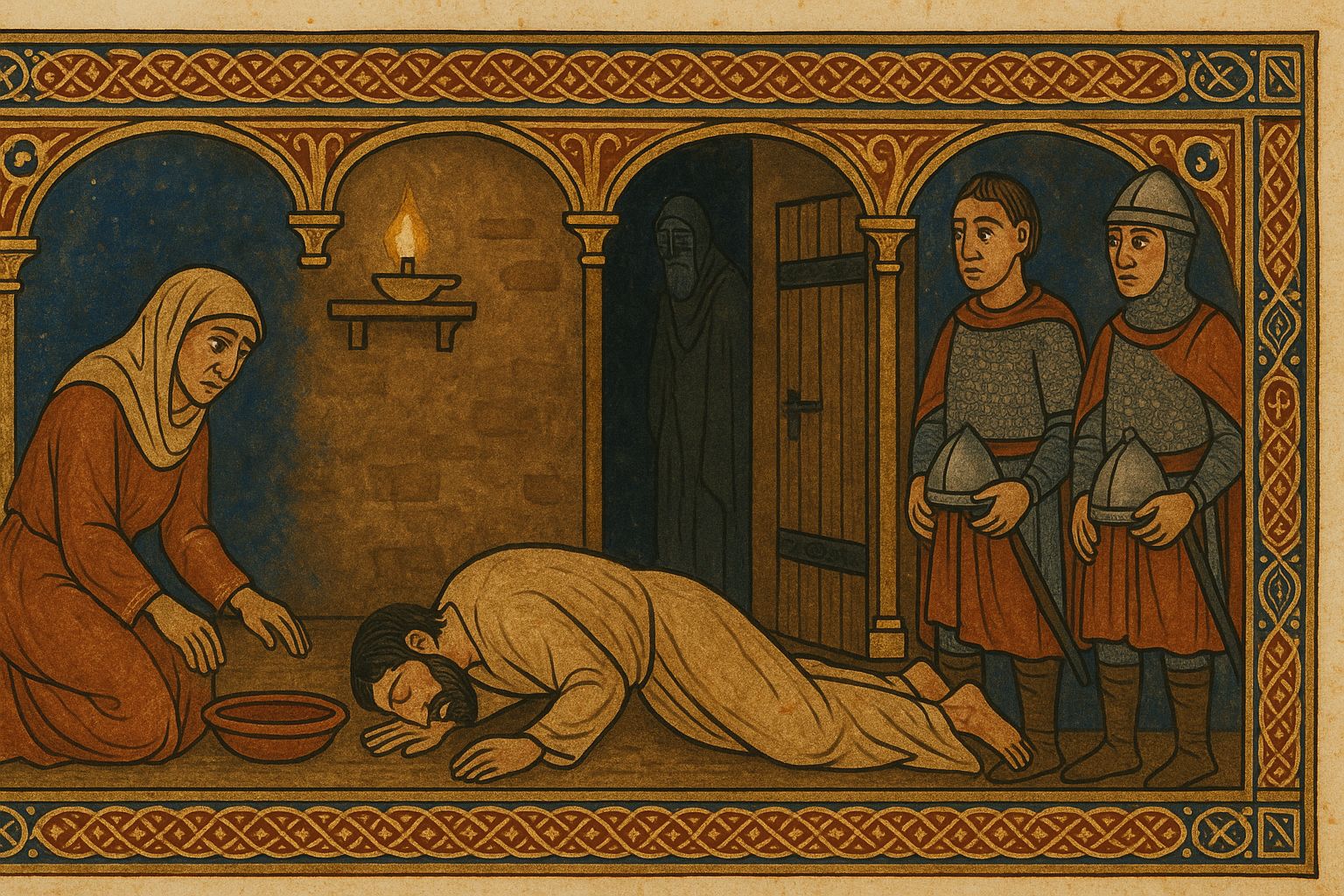
She looked at him a long time then. Whatever she saw in his face decided her. She turned and went into the back of the house and came out with a low bowl of dark clay and set it on the floor between them. She knelt. He did not kneel. The two men with him stood by the door and did not move.
“Whom shall I bring up unto thee?” she asked.
“Bring me up Samuel.”
She lowered her face over the bowl.
For a long while there was nothing. Outside a dog barked once and then was still. He listened to his own breathing and found it loud and tried to quiet it and could not.
Then the woman screamed.
She lifted her face and she did not look at the bowl; she looked at him. Her mouth was open and her hands were spread. Why hast thou deceived me? for thou art Saul.
“Be not afraid,” he said. His own voice sounded far away. “What sawest thou?”
She did not answer him at once. She was looking past him. She was looking at the corner of the room where the lamp did not reach. I saw gods ascending out of the earth.
“What form is he of?”
An old man cometh up; and he is covered with a mantle.
Then he knew, and he stooped, and put his face to the ground.
There were not, in that small house, more than four breaths drawn between them. Saul breathed. The woman breathed. The two men by the door, breathing. And then the voice came.
Why hast thou disquieted me, to bring me up?
It was Samuel’s voice. It was no one else’s. It was the voice that had said to obey is better than sacrifice; it was the voice that had turned away from him at Gilgal and not looked back. The voice came from the corner where the lamp did not reach.
He did not lift his head from the floor. He spoke into the dirt. I am sore distressed; for the Philistines make war against me, and God is departed from me, and answereth me no more, neither by prophets, nor by dreams: therefore I have called thee, that thou mayest make known unto me what I shall do.
There was the silence of a man who has heard such a thing before and has nothing in him left to say of it.
Then: Wherefore then dost thou ask of me, seeing the LORD is departed from thee, and is become thine enemy?
He felt the dirt against his forehead. There was a small stone there. He could feel it pressing into the bone above his eye.
The LORD hath rent the kingdom out of thine hand, and given it to thy neighbour, even to David. Moreover the LORD will also deliver Israel with thee into the hand of the Philistines: and tomorrow shalt thou and thy sons be with me.
The voice did not raise itself. It did not need to. It was the voice of a thing long ago decided, only now being said aloud.
He did not rise. He could not. His arms had gone out of him and his legs had gone out of him and the strength of a man who had once been taller than all his people had gone out of him, and he lay on the floor of a witch’s house in Endor as a sack of grain lies, full and heavy and without will. The two men at the door did not come to him. They did not know how.
The woman came to him.
She knelt by him and she put her small dry hand on his shoulder. She did not flinch from him. She was not afraid of him any longer.
Behold, she said, thine handmaid hath obeyed thy voice, and I have put my life in my hand, and have hearkened unto thy words which thou spakest unto me. Now therefore, I pray thee, hearken thou also unto the voice of thine handmaid, and let me set a morsel of bread before thee; and eat, that thou mayest have strength, when thou goest on thy way.
He shook his head against the floor. I will not eat.
The two men at the door spoke then, gently, as men speak to a horse that is past speech. They lifted him onto the bed and sat him there. He sat on the edge of the bed with his hands on his knees and his eyes on nothing.
The woman went out.
He heard her in the yard. He heard the bleating of a calf that did not know yet. He heard the calf grow quiet. He heard her come back into the house and he heard the fire in the oven and the smell of meal and water mixed and laid against hot stone, and these were the smells of his mother’s house when he had been a boy in Gibeah, and of his own house at the beginning, and of every house in Israel through every generation, the smell of unleavened bread on a fire at night.
She brought it to him on a plate of clay. The meat of the calf was on the plate. There was no salt. There was no wine. There was a clean cloth she had laid across her knee to carry it.
He ate.
He ate because she set it before him, and because the men with him put their hands beneath his arms and lifted them, and because the body is a stubborn creature and will eat at the end of itself.
When he was done he rose. He was steady on his feet. The dust of her floor was on his forehead and he did not wipe it off.
At the door he looked once at her. She had gathered the plate and the cloth and she was standing with them in her arms. The lamp behind her had burned down to a low yellow, and her shadow lay long and thin across the packed floor and out into the yard where the calf had been.
He went out. The two men went after him.
The grass was still wet. The Philistine fires on the hill at Shunem had not gone out. They would not go out before morning. He walked east and then south, toward Gilboa, toward the camp, toward the day that was coming, and behind him in the doorway the woman of Endor stood with the empty plate against her chest and watched the dark take him until she could not see him any more.